


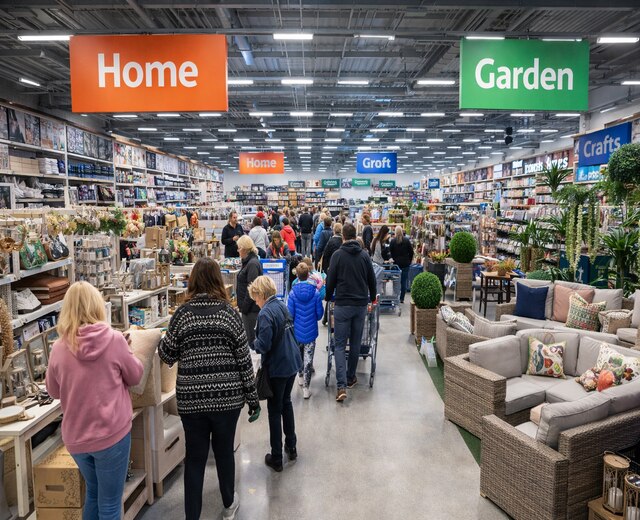
The Range has opened a new-format superstore in Ruislip, marking the rollout of what the retailer describes as an evolved store concept designed to broaden its offer and modernise the in-store experience. The launch represents the latest step in the company’s national expansion strategy as it seeks to strengthen its presence across Greater London and the South East.
The Ruislip site introduces an updated layout and a wider product mix, combining homeware, DIY, garden and seasonal ranges under one roof. The retailer says the concept aims to create a more intuitive shopping journey while responding to shifting consumer expectations around convenience and variety.
A Broader Retail Proposition
The new Ruislip superstore reflects The Range’s ambition to move beyond a traditional discount homeware model towards a more comprehensive retail destination. The store includes expanded home décor collections, soft furnishings, craft supplies and outdoor living products, alongside everyday essentials.
Retail analysts have noted that UK consumers continue to balance value with quality amid ongoing cost-of-living pressures. In that context, multi-category retailers have gained traction by offering competitive pricing across diverse departments. The Range’s updated format appears designed to capitalise on that demand, encouraging longer dwell times and higher basket values.
The Ruislip opening also reinforces the company’s investment in physical retail at a time when some competitors have scaled back bricks-and-mortar operations. While online sales remain important across the sector, retailers with flexible store formats have increasingly focused on experiential layouts and convenience-driven locations.
Strategic Location in West London
Ruislip, situated in the London Borough of Hillingdon, provides access to a densely populated catchment area with strong commuter links into central London. The decision to launch the new concept there signals confidence in sustained consumer footfall and local spending power.
Retail sector data shows that out-of-town and retail park locations continue to perform steadily, particularly where parking access and large-format stores support bulk purchases. The Range’s model, which often relies on spacious units capable of housing wide inventory, aligns closely with that trend.
The company has not disclosed detailed financial projections for the Ruislip branch. However, new store openings typically generate short-term local economic impact through job creation, supply chain activity and increased foot traffic to neighbouring retailers.
Employment and Local Impact
New store launches of this scale generally create a mix of full-time and part-time roles across sales, logistics and management. While specific staffing figures for Ruislip have not been publicly detailed, The Range has historically emphasised local recruitment as part of its community engagement approach.
For local authorities, large retail openings can contribute to business rates revenue and revitalise commercial areas. In Greater London, where high street vacancy rates have fluctuated in recent years, inward retail investment remains closely watched by councils and business groups.
Industry observers suggest that retailers able to adapt store formats to regional demand are better positioned to sustain long-term growth. The Ruislip concept may serve as a template for further rollouts if customer response proves positive.
Retail Sector Context
The UK retail landscape has undergone significant restructuring since 2020, shaped by pandemic disruption, inflationary pressures and changing consumer habits. Home improvement and homeware retailers saw elevated demand during periods of lockdown, followed by more measured growth as household budgets tightened.
Against that backdrop, The Range has continued to expand selectively. The company, founded in Plymouth in 1989, has grown into one of the UK’s largest home, leisure and garden retailers, operating hundreds of stores nationwide.
The introduction of a “new superstore concept” suggests a refinement rather than a reinvention of its core model. Retail analysts frequently highlight the importance of store evolution from improved signage and layout to diversified product partnerships in sustaining relevance within competitive segments.
Customer Experience and Format Evolution
Modern large-format retail increasingly emphasises layout clarity, category zoning and cross-department merchandising. The Ruislip store’s updated design is intended to enhance navigation and create clearer distinctions between seasonal, decorative and practical ranges.
Garden and outdoor living categories remain particularly significant for multi-category retailers, especially during spring and summer trading periods. Expanded space allocation for these lines may help capture seasonal uplift, which can materially influence annual revenue performance.
Retail specialists note that experiential elements, such as visually styled home displays — can also drive impulse purchasing and strengthen brand identity. By refreshing its superstore blueprint, The Range appears to be aligning with these broader retail design trends.
Implications for the London Retail Market
London presents both opportunity and complexity for national chains. Property costs, competition and consumer expectations are typically higher than in regional markets. However, successful sites can deliver strong brand visibility and sustained revenue.
The Ruislip opening underscores continued retailer confidence in parts of the capital’s suburban retail market. With transport links and established residential communities, West London locations often attract consistent weekend and family-oriented footfall.
For consumers, the arrival of a large-format home and leisure store may widen choice in an area already served by established retail parks and high street brands. Increased competition can influence pricing strategies and promotional activity across neighbouring outlets.
