


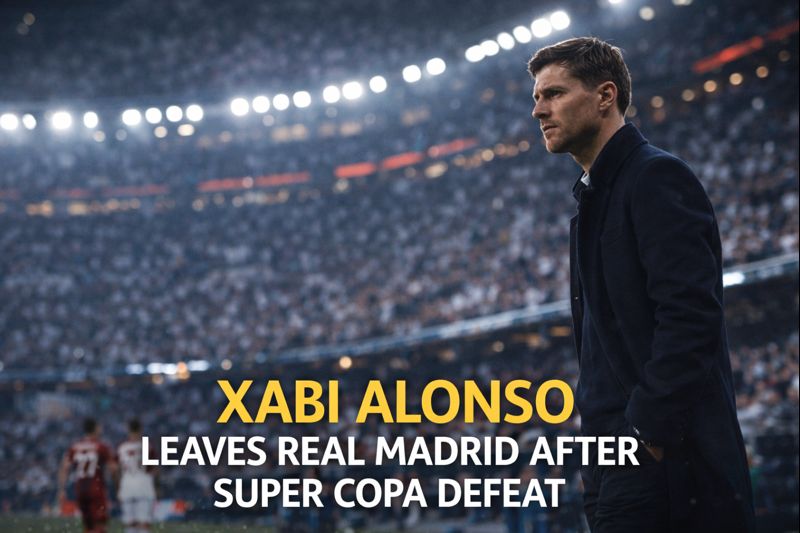
Xabi Alonso’s brief but eventful managerial spell at Real Madrid has come to an end after less than eight months in charge of one of world football’s biggest clubs. Following a gripping 3–2 defeat to Barcelona in the Spanish Supercopa final, the club and Alonso agreed to part ways, a decision that marks a dramatic conclusion to what began as a highly anticipated chapter in both his managerial career and Real Madrid’s recent history.
Alonso’s appointment on 25 May 2025 had been met with optimism after an impressive period at Bayer Leverkusen, where he guided the German side to domestic success and established himself as one of Europe’s most promising young managers. Real Madrid entrusted him with restoring the club’s dominance in Spanish and continental competitions, following a long and storied playing career that included spells at Liverpool, Real Madrid and Bayern Munich.
However, the transition from coaching in the Bundesliga to managing at the heart of elite Spanish football proved more challenging than many anticipated. Real Madrid’s season under Alonso began strongly, with a string of positive results and a La Liga Manager of the Month award in August 2025, reflecting early promise. Yet, inconsistency and physical demands soon took their toll, with fitness and injury concerns emerging as recurring themes during his tenure.
The Supercopa final defeat in Saudi Arabia not only denied Real Madrid an early season trophy but, according to multiple reports, also served as a catalyst for the club’s decision to move in a different direction. Despite a respectable record throughout the campaign, the defeat to Barcelona appeared to crystallise underlying issues related to tactical cohesion and physical sharpness within the squad, concerns amplified by ongoing calls from media and supporters alike for improved conditioning and resilience.
Tactically, Alonso had sought to instil a possession-based, flexible system, drawing on his own experiences as a midfielder and his success at Leverkusen. Yet, at Real Madrid, balancing this approach with the physical intensity of Spanish football and the high expectations of the club hierarchy proved a delicate task. With more than 20 injuries recorded through mid-season, and key players like Kylian Mbappé and Vinícius Júnior experiencing fitness fluctuations, questions about squad readiness became unavoidable.
Before his exit, Alonso was notably cautious in managing player fitness, including decisions about Mbappé’s participation, reflecting a pragmatic approach to risk management. In a press conference prior to the Supercopa final, he emphasised measured decision-making, stating that the coaching staff and medical team would collectively assess player readiness, underscoring the priority placed on long-term welfare over short-term gains.
Inside the match itself, Alonso’s side showed moments of strong character and tactical discipline, but ultimately fell short against a Barcelona side that displayed cohesion and ruthlessness in key moments. Post-match reactions from the coach, while expressing disappointment, highlighted pride in his players’ effort and acknowledged areas for growth, a blend of sentiment that spoke to both competitive intensity and developmental challenges.
Real Madrid’s senior leadership, however, judged that the club’s aspirations required a fresh impetus. According to breaking reports, the decision to part ways was mutual, avoiding an abrupt sacking but nonetheless signalling a shift in direction. Álvaro Arbeloa, a former Real Madrid player and coach of the club’s Castilla side, has been named as Alonso’s successor, tasked with stabilising the team and preparing for upcoming fixtures in La Liga and domestic cup competitions.
The departure of Alonso not only closed his chapter at Real Madrid but also raised broader questions about managerial expectations in elite football. At a club where success is often non-negotiable, a string of promising results was ultimately overshadowed by inconsistent performances at pivotal moments. The convergence of tactical ambition, injury management and high-stakes fixtures proved more difficult to navigate than many pundits expected.
For Alonso himself, the experience is unlikely to define his managerial career negatively; rather, it represents a high-pressure learning environment that could shape his future approach. After his remarkable success at Leverkusen, where he delivered a historic Bundesliga title and cultivated an attacking, high-possession team, Alonso’s tactical credentials remain esteemed among coaching circles. Football analysts suggest that his next role, whether in the Premier League or back in Germany, will benefit from the intense scrutiny and lessons of the Real Madrid tenure.
In Spain’s football media and fan communities, reactions have been mixed. Some observers view Alonso’s departure as inevitable given Real Madrid’s trophy expectations, while others point to systemic issues within the squad and league competitiveness as mitigating factors. A recurring theme in commentary is the suggestion that Alonso’s philosophy might have flourished with greater continuity and support, rather than the rapid managerial turnover that characterises elite clubs.
The legacy of Alonso’s Real Madrid journey will likely be assessed in the context of both what was achieved and what might have been. His vision for the team, rooted in positional play and tactical nuance, contrasted with the club’s historic emphasis on immediate success. Whether future roles at other top clubs materialise for Alonso remains a topic of speculation among transfer commentators and football strategists alike.
As Real Madrid moves forward under Arbeloa’s stewardship, the club’s challenge will be to harness the lessons of this campaign, balancing tactical evolution with physical readiness and squad harmony. For Xabi Alonso, a manager whose career continues to unfold, the next chapter may yet reinforce his reputation as one of the most intriguing strategic minds in modern football, one shaped as much by challenges as by triumphs.
