


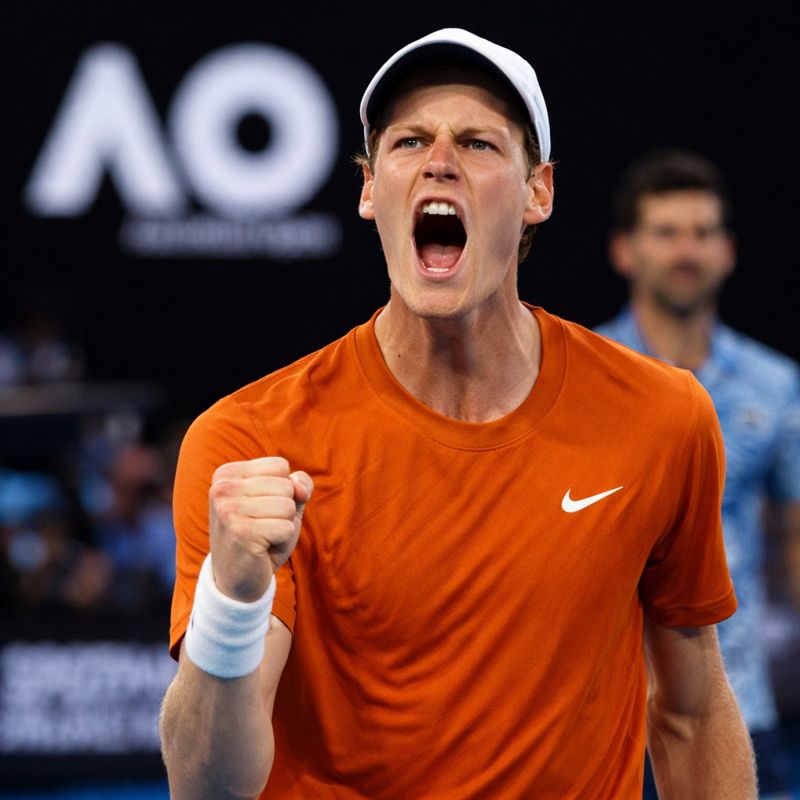
Jannik Sinner has been at the centre of one of the most compelling matches at the 2026 Australian Open, where the Italian world number two’s semi-final clash with Novak Djokovic has evolved into a gripping five-set duel under the roof of Melbourne’s Rod Laver Arena. The contest has pitted Sinner’s relentless power and tactical precision against Djokovic’s legendary resilience in what has become a defining moment of this year’s tournament.
Sinner entered the match as the defending champion and one of the sport’s most consistent performers on hard courts. At 24, he has already established himself among the elite of men’s tennis, completing a rare feat in 2025 by defending his Australian Open title and later adding Wimbledon to his Grand Slam tally, underlining his versatility across surfaces.
A Battle of Generations at the Rod Laver Arena
From the outset, this semi-final was expected to be a clash of styles and experience. Sinner, known for his heavy hitting from the baseline and sharp first serve, took early initiative by capturing the first and third sets with authoritative 6-3 and 6-4 victories respectively. His combination of aggression and strategic placement unsettled Djokovic, forcing the Serbian veteran into defence during pivotal rallies.
Djokovic, at 38 one of the most decorated players in history, responded with characteristic tenacity. After dropping the opening set, he recalibrated his approach and claimed the second set 6-3, bolstered by a stronger return game and targeted pressure on Sinner’s second serves. He then combined precision with patience to win the fourth set 6-4, forcing the match into a decisive fifth set.
On a night that drew comparisons to some of the sport’s greatest generational duels, Djokovic’s experience was evident in his ability to absorb early momentum from Sinner and counter with tactical awareness. In contrast, Sinner’s composure under pressure, particularly in long rallies, highlighted the Italian’s development as a Grand Slam contender.
Tactical Depth and Physical Demands
What has distinguished this encounter is not just the back-and-forth nature of the sets, but the physical toll on both competitors. Long rallies, sharp directional changes and consistently high intensity have tested endurance as much as skill. Sinner’s aggressive forehand, one of his signature strengths, repeatedly dragged Djokovic outside the baseline, while Djokovic’s ability to absorb pace and redirect the ball kept Sinner on alert.
Statistical analysis from recent coverage also points to nuanced edges in key areas. At this tournament, Djokovic’s return of second serves has been notably effective, winning close to 59 per cent of such points compared with Sinner’s own hold rate of just over 55 per cent on second serves. These marginal differences often prove decisive in tightly contested matches such as this.
A Semi-Final with Broader Significance
Beyond the immediacy of the match, Sinner’s performance reflects his growing stature in men’s tennis. Over the past two seasons, he has consistently challenged the sport’s established figures, bringing a powerful blend of athleticism, tactical maturity and mental resilience to Grand Slam stages. His run to this semi-final follows a remarkable period in which he has become one of the few players to defend a major title successfully in recent years, a testament to his sustained excellence.
Djokovic’s presence in this high-stakes encounter also underscores his enduring place in the sport. Despite advancing age by tennis standards, he continues to reach the latter stages of major tournaments, adapting his game and leveraging his vast reservoir of experience. That he is still capable of stretching a top-class opponent like Sinner over five sets speaks to the depth of his competitive instincts.
This semi-final has drawn comparisons with other riveting matches at the 2026 Australian Open, including the preceding match in which Carlos Alcaraz overcame Alexander Zverev in a tense five-set battle, underscoring the depth of competition at this year’s event.
The Decider and What’s Next
As the contest entered the fifth set, both players showed signs of physical strain but maintained a high standard of play, with the momentum oscillating in response to key points. For Sinner, the challenge has been to maintain his early aggression while navigating Djokovic’s late-tournament hunger for Grand Slam success. For Djokovic, it has been a test of endurance and tactical adaptation against a younger, powerful opponent.
The winner of this gripping semi-final will face Carlos Alcaraz, who overcame Zverev in the tournament’s longest match, in what promises to be a fascinating final. Alcaraz’s path to the final and his own expressions of sheer determination following his victory have already added another layer of narrative to the championship’s closing stages.
What This Means for Sinner’s Legacy
Regardless of the ultimate outcome in the deciding set, Sinner’s performance in this semi-final further cements his reputation as one of tennis’s leading figures. His ability to compete toe-to-toe with a player of Djokovic’s calibre at this stage of a Grand Slam reinforces the broader shift in the men’s game, where tactical intelligence and physical preparation are carried equally with raw power and shot-making ability.
