


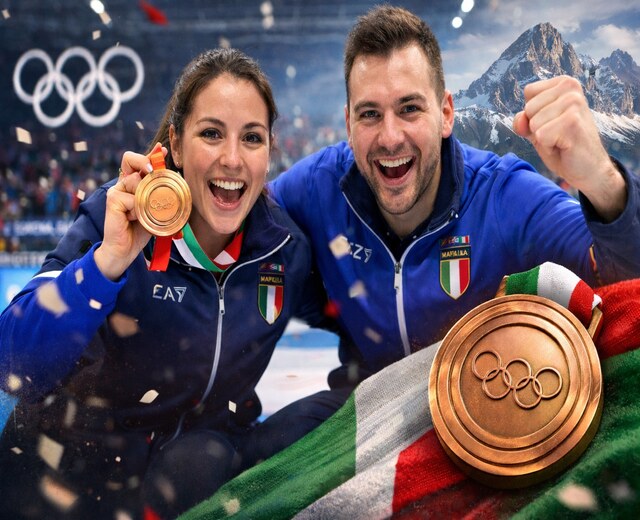
In a compelling climax to the mixed doubles curling event at the 2026 Winter Olympics in Milano-Cortina, Italian stars Stefania Constantini and Amos Mosaner delivered a memorable performance on home soil to secure the bronze medal. The result, announced on Tuesday at the Cortina Curling Olympic Stadium, brought cheers from partisan crowds and added to Italy’s burgeoning winter sports success at the Games.
Italy’s curling duo, who had entered the competition as one of the favourites based on past achievements, overcame a narrow semi-final defeat to the United States before reclaiming momentum to beat Great Britain 5-3 in the bronze medal match.
Olympic Glory and Home Pressure
Constantini and Mosaner are no strangers to Olympic podiums. The pair first captured global attention when they brought Italy its first ever Olympic curling gold in the mixed doubles discipline at the 2022 Beijing Winter Games, a historic moment for a sport long dominated by northern European and North American powers.
Their title defence at Milano-Cortina was shaped by contrasting narratives of expectation and opportunity. Competing in front of home supporters in Cortina d’Ampezzo, Constantini, a native of the host town, spoke in the lead-up to the Games about the emotional significance of performing in familiar surroundings and the chance to elevate curling’s profile in Italy.
Mosaner, who carried the Italian flag during the Opening Ceremony, echoed that sentiment, highlighting how rare it is for athletes to compete at an Olympic event hosted in their home region. Their preparation through the 2025 season, following a reunion after a temporary split post-Beijing, positioned them as contenders for another medal.
Tournament Highs and Lows
The mixed doubles curling event at Milano-Cortina featured ten teams in a round-robin format, with the top four progressing to the semi-finals. After advancing comfortably through the early rounds, Italy faced the United States in a tightly contested semi-final, ultimately losing 9-8 in a match that swung on momentum shifts and clutch shots.
The United States will go on to compete for the gold medal against Sweden, a first in the discipline for the Americans, while Italy turned its focus to the bronze medal game.
Constantini and Mosaner met Britain’s Jennifer Dodds and Bruce Mouat, a pair that had impressively topped the round-robin standings in a rematch that evoked memories of recent world championship encounters. The Italians leveraged their experience and tactical acumen to control the bronze medal match, building an early lead and maintaining composure under pressure.
A pivotal moment arrived in the sixth end when Constantini delivered a precise final stone through a narrow gap, securing a key point and shifting the contest in Italy’s favour. From that point, the home pair managed the closing ends with strategic discipline, sealing the 5-3 victory and triggering enthusiastic celebration among the crowd.
Significance Beyond the Medal
Italy’s bronze not only reflects the quality and depth of Constantini and Mosaner’s performance but also underscores the evolving landscape of Olympic curling. Since mixed doubles was introduced to the Winter Games programme in 2018, it has grown in competitiveness, with nations such as the United States and Sweden now emerging as serious challengers.
For Team GB, the defeat represented another near-miss on the Olympic stage. Despite strong form in the round robin and individual improvement since Beijing 2022, finishing fourth carries a familiar sting, all the more so against a backdrop of increasing expectation from British supporters.
Yet for Italy, the result carries broader implications. Constantini and Mosaner’s success on home soil, combining Olympic history with present-day excellence, has the potential to deepen public interest in curling across the country. In a nation where winter sports success has traditionally centred on alpine skiing and figure skating, their achievements continue to illuminate curling as a discipline worthy of attention and investment.
Already, the 2025 season and Italy’s performance at these Games have inspired conversation about the sport’s future in Italian ice sport culture, particularly in regions such as Cortina and Trentino where curling has longstanding local roots.
