



Rental affordability has become an increasingly prominent issue across the UK, with pressures varying significantly by region. While rising housing costs are often discussed at a national level, official data suggests that local factors play a decisive role in shaping rental outcomes for households.
According to figures published by the Office for National Statistics, average private rents have continued to increase across most regions, though the pace of growth has differed sharply between urban centres and less densely populated areas. These variations reflect differences in local demand, housing supply, and labour market conditions rather than a single national trend.
Demand Concentration in Urban Areas
Major cities and employment hubs have experienced some of the strongest rental pressures. Areas with high job density, universities, and transport connectivity tend to attract sustained demand from renters, particularly younger households and mobile workers.
ONS data shows that rental growth has remained elevated in parts of London, the South East, and several regional cities, even during periods of broader economic uncertainty. Analysts have linked this pattern to constrained housing supply combined with continued inward migration for work and education.
As demand concentrates in these areas, affordability pressures tend to intensify more quickly than in regions where population growth is slower.
Supply Constraints and the Private Rental Sector
The availability of rental housing has become a key factor influencing affordability. In many regions, the supply of private rental homes has not expanded in line with demand, placing upward pressure on rents.
The Bank of England has previously noted that changes in financing conditions can influence landlord behaviour. Higher borrowing costs and regulatory requirements may affect decisions to enter or exit the private rental sector, with implications for overall supply.
When supply growth lags demand, even modest increases in tenant numbers can result in disproportionate rent increases, particularly in competitive local markets.
Regional Income Differences and Affordability Gaps
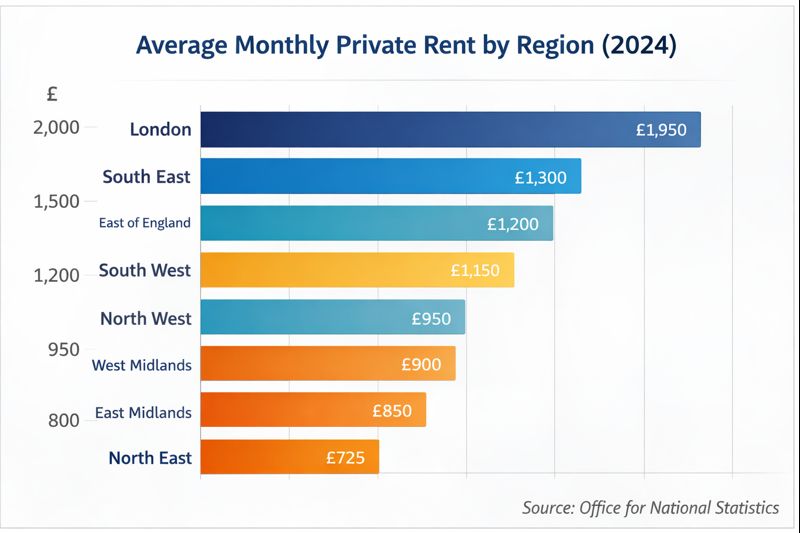
Rental affordability is shaped not only by rent levels but also by local income patterns. In regions where wage growth has not kept pace with housing costs, renters may face greater financial strain even if headline rents appear lower than in major cities.
Analysis from public finance bodies has highlighted that households in lower-income regions often spend a higher proportion of earnings on housing. This dynamic can reduce disposable income and limit financial resilience, especially during periods of rising living costs.
As a result, affordability challenges are not confined to high-rent areas alone but can emerge wherever income growth and housing costs become misaligned.
Social Housing Pressures and Spillover Effects
Pressure within the private rental market is closely linked to conditions in the social housing sector. Limited availability of social housing can push more households into the private market, increasing competition for rental properties.
The National Audit Office has previously reported on long-standing shortfalls in social housing provision. These constraints can have spillover effects, particularly in regions where demand for lower-cost housing exceeds supply.
Housing economists, including Kate Barker, have argued that insufficient social housing investment can amplify affordability challenges across the wider rental market by concentrating demand in fewer segments.
Policy Measures and Local Market Responses
Policy interventions aimed at improving rental affordability have tended to focus on specific aspects of the market, such as tenant protections or incentives for new housing delivery. While these measures can provide short-term relief, their effectiveness often depends on local implementation and market conditions.
Experts at institutions such as the Institute for Fiscal Studies have noted that structural affordability issues are difficult to resolve without sustained increases in housing supply. Regulatory changes alone may influence behaviour at the margins but are unlikely to offset prolonged supply-demand imbalances.
This helps explain why affordability pressures persist across multiple regions despite varied policy approaches.
The Broader Economic Implications
Rental affordability has implications beyond housing security. High housing costs can influence labour mobility, as workers may be less willing or able to relocate to areas with stronger job prospects. Over time, this can affect regional productivity and economic growth.
Businesses in high-cost areas may also face recruitment challenges, while households may reduce spending elsewhere to accommodate rising rents. These secondary effects highlight why rental affordability is increasingly viewed as a broader economic issue rather than a purely housing-related concern.
A Regionally Fragmented Challenge
Changes in rental affordability across the UK reflect a complex interaction between local demand, housing supply, income growth, and policy frameworks. While national trends provide useful context, regional dynamics ultimately determine how renters experience affordability pressures.
As official data continues to show uneven outcomes across the country, understanding these regional differences remains central to assessing the future of the UK rental market. Without sustained adjustments to supply and income growth, affordability is likely to remain a key issue for households and policymakers alike.
Read More on British Wire
