


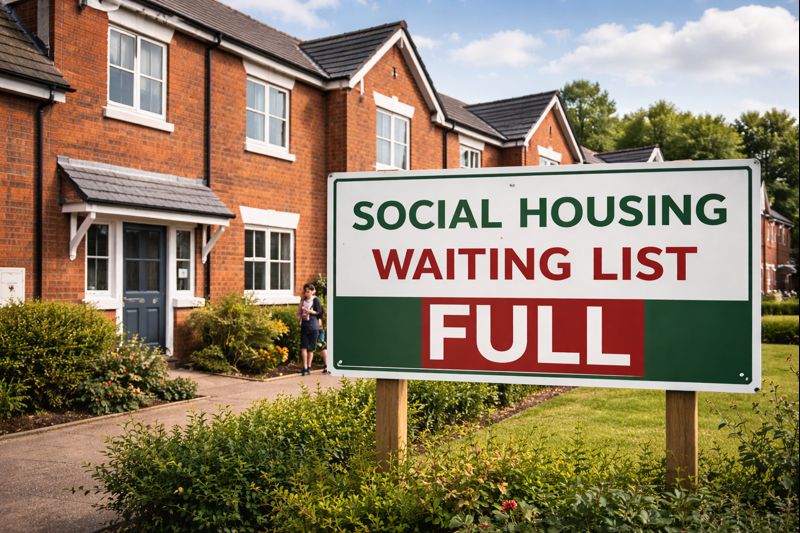
Demand for social housing in the UK has continued to rise faster than supply, creating sustained pressure on local authorities and households. While private rental and home ownership markets attract much of the public attention, social housing plays a critical role in providing stable, affordable accommodation for lower-income households and those with specific needs.
Official housing records indicate that the gap between households seeking social housing and the number of available homes has widened steadily over the past decade. This imbalance reflects long-term structural factors rather than short-term market fluctuations.
Rising Waiting Lists Across Local Authorities
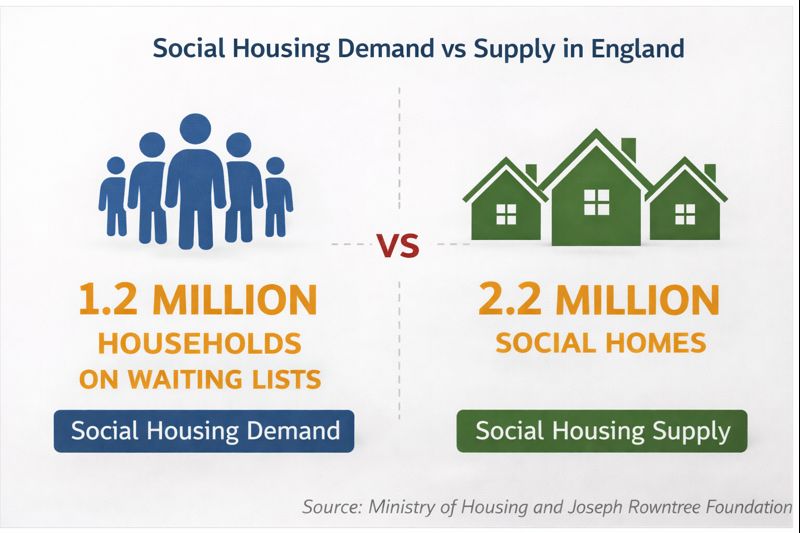
Data compiled by the Ministry of Housing, Communities and Local Government and referenced in sector reviews shows that more than 1.2 million households are currently recorded on social housing waiting lists in England. While figures vary by council, the overall trend has remained upward.
Urban authorities with high housing costs tend to report the longest waiting lists, but pressures are increasingly visible in smaller towns and regional centres as well. Analysts note that population growth, longer tenancies, and limited new supply all contribute to reduced turnover in the social housing stock.
As a result, households may wait several years before being offered suitable accommodation.
Declining Social Housing Stock
One of the key drivers behind rising demand is the long-term decline in the number of social homes available. According to sector-wide analysis from the Chartered Institute of Housing, the total stock of social rented homes in England has fallen by several hundred thousand units since the early 2000s.
While new affordable housing is being delivered each year, losses from demolition, regeneration schemes, and conversions have often offset new supply. In some years, net additions to the social housing stock have been minimal.
This slow replenishment rate has limited the system’s ability to absorb rising demand.
The Role of Right to Buy and Stock Losses
Policy mechanisms have also influenced long-term supply levels. The Right to Buy scheme has enabled millions of households to purchase their council homes over several decades. However, replacement rates have varied significantly by region and funding arrangements.
Research cited by the Resolution Foundation suggests that only a fraction of homes sold under Right to Buy have been replaced on a one-for-one basis, particularly in high-cost areas where land and construction costs are higher.
This has contributed to a gradual reduction in available social housing, especially in locations with the greatest need.
Funding Constraints and Development Capacity
Building new social housing requires sustained public investment, access to land, and delivery capacity. Funding allocations for affordable housing programmes are often set several years in advance, limiting flexibility when demand rises unexpectedly.
Evidence presented by housing associations to parliamentary committees shows that development pipelines are sensitive to construction costs, borrowing conditions, and grant certainty. When costs rise or funding becomes less predictable, planned schemes may be delayed or scaled back.
These constraints help explain why social housing supply responds slowly to changing demand patterns.
Regional Differences in Social Housing Pressure
Demand for social housing is not evenly distributed across the UK. Areas with higher private rents and lower average incomes tend to experience the greatest pressure, as more households struggle to access market housing.
Analysis by the Joseph Rowntree Foundation has highlighted that households in insecure or low-paid work are increasingly reliant on social housing to maintain stable living conditions. In regions where affordable options are limited, demand intensifies even further.
This regional variation makes national targets difficult to apply uniformly.
Broader Impacts on Housing and Public Services
High demand for social housing has implications beyond accommodation itself. Temporary accommodation costs for councils have risen, while households placed far from work, schools, or support networks may experience additional hardship.
Local authority financial reports show that temporary accommodation spending has increased sharply in recent years, reflecting shortages in permanent social housing options. This places further strain on council budgets already under pressure from rising service demands.
Over time, these costs can outweigh the upfront investment required to expand social housing supply.
A Structural Issue Without a Quick Fix
The continued imbalance between social housing demand and supply reflects long-term policy choices, funding structures, and delivery constraints. While short-term measures can alleviate pressure at the margins, meaningful change typically requires sustained investment over many years.
Housing policy specialists broadly agree that stabilising demand will depend on increasing net additions to social housing stock, improving replacement rates, and aligning funding with local need. Without such measures, demand is likely to remain elevated relative to supply.
Read More on British Wire
