


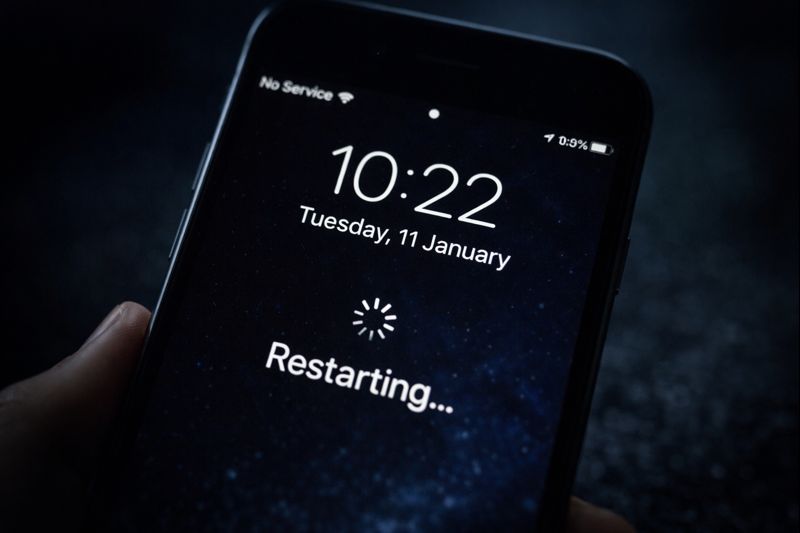
Apple has confirmed the existence of a sophisticated class of cyber attacks capable of forcing iPhone devices to restart repeatedly, a tactic that security researchers say can disrupt protections designed to safeguard user data. While the company has acknowledged the threat, it has also conceded that there is currently no direct fix available for most users, raising fresh concerns about the limits of mobile security even on tightly controlled platforms.
The issue, first detailed by security researchers and later confirmed by Apple, centres on targeted attacks that exploit system behaviour rather than traditional software vulnerabilities. By triggering repeated restarts, attackers can interfere with certain defensive mechanisms and create opportunities for further exploitation, particularly against high-value targets.
What Are iPhone Restart Attacks?
Unlike conventional malware attacks that rely on malicious apps or software flaws, restart attacks operate at a more subtle level. They are designed to destabilise a device by forcing it to reboot repeatedly, preventing some security features from functioning as intended.
Security specialists say the technique is especially concerning because it does not always require persistent access to the device. Instead, it relies on carefully timed triggers that exploit how modern smartphones manage memory, encryption states and background processes during restarts.
Apple has confirmed that it is aware of these attacks and has been tracking them as part of its ongoing threat intelligence work. However, the company has stressed that the attacks appear to be highly targeted rather than widespread.
Who Is at Risk?
According to Apple and independent researchers, the vast majority of iPhone users are unlikely to be affected. The attacks are believed to be directed primarily at individuals of specific interest, such as journalists, political figures, activists and others who may be targeted by state-linked or highly resourced threat actors.
That distinction matters. Apple has repeatedly argued that its security model is designed to protect everyday users from mass exploitation, while advanced attacks of this kind fall into a narrower category of espionage-style threats.
Nevertheless, the confirmation that such attacks exist, and that there is no immediate fix for most users, highlights the growing sophistication of mobile surveillance techniques.
Why There Is No Immediate Fix
Apple’s admission that there is no direct remedy reflects the technical complexity of the problem. Restart behaviour is deeply embedded in how iPhones manage system stability, encryption and performance. Changing that behaviour without unintended consequences is not straightforward.
In statements to researchers, Apple has indicated that it continues to harden its operating systems against advanced threats, but that some mitigations take time to design, test and deploy safely. In the meantime, the company is relying on a combination of existing safeguards and optional security features aimed at those most at risk.
This approach mirrors Apple’s handling of previous high-end threats, where fixes were introduced gradually rather than through emergency updates that could affect millions of devices.
Lockdown Mode and Its Limits
One of the few defences Apple currently offers against extreme threats is Lockdown Mode, a highly restrictive security setting introduced in recent versions of iOS. Designed for users who believe they may be targeted by advanced cyber attacks, Lockdown Mode significantly reduces the device’s attack surface.
However, Apple has been clear that Lockdown Mode is not intended for general use and may not fully neutralise restart-based attacks. The company describes it as part of a broader defensive strategy rather than a guaranteed solution.
For most users, Lockdown Mode’s limitations and usability trade-offs mean it is unlikely to be adopted unless there is a clear and credible risk.
What Apple Is Saying
Apple has sought to balance transparency with reassurance. The company has confirmed the existence of restart attacks but has emphasised that there is no evidence of large-scale exploitation affecting ordinary users.
In line with its usual practice, Apple has avoided providing technical details that could assist attackers, instead focusing on its broader commitment to user privacy and security. It has also reiterated that it works closely with researchers and regularly updates its threat models to address emerging risks.
This measured response reflects Apple’s broader security philosophy, which prioritises systemic protections over reactive fixes wherever possible.
A Wider Pattern in Mobile Security
The emergence of restart attacks fits into a broader trend in which attackers increasingly target system behaviour rather than software bugs. As mobile operating systems become more secure, traditional exploits are harder to execute at scale, pushing sophisticated actors towards indirect techniques.
Experts note that this shift complicates the relationship between vendors and users. While companies like Apple can credibly claim that everyday users remain well protected, the existence of advanced attacks underscores the reality that no system is entirely immune.
For policymakers and regulators, such developments also raise questions about transparency, accountability and the responsibilities of technology companies when dealing with threats that affect only a small but vulnerable group.
What Users Can Do
For most iPhone owners, there is little immediate action required. Keeping devices up to date, avoiding suspicious links and downloads, and using strong authentication measures remain the most effective steps for reducing risk.
Those who believe they may be at higher risk are encouraged to review Apple’s advanced security options and seek guidance from digital security professionals. In some cases, behavioural changes, such as limiting device exposure or separating sensitive communications, may be more effective than technical fixes alone.
Apple has also encouraged users to report suspected attacks, helping the company and researchers improve their understanding of how these techniques are being deployed.
Trust, Transparency and Expectations
Apple’s handling of restart attacks illustrates the tension between maintaining public confidence and acknowledging the realities of modern cyber threats. By confirming the issue while downplaying its impact on most users, the company is attempting to strike a careful balance.
For consumers, the episode serves as a reminder that security is not a static guarantee but an ongoing process shaped by evolving risks. For Apple, it reinforces the challenge of protecting a global user base while confronting threats that operate at the very edges of technical possibility.
A Problem Without a Simple Answer
The confirmation of iPhone restart attacks does not represent a sudden failure of Apple’s security model. Rather, it highlights the limits of even the most sophisticated defences in the face of determined and well-resourced adversaries.
While most users are unlikely to be affected, the absence of a direct fix underscores the reality that some threats cannot be eliminated overnight. How Apple addresses this challenge in future updates will be closely watched, not only by security researchers but by governments and users who increasingly rely on smartphones as repositories of their most sensitive data.
