


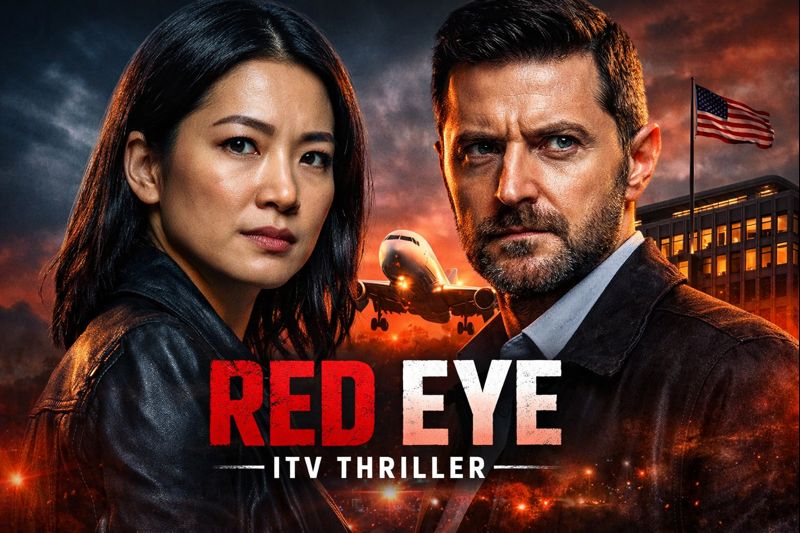
ITV’s thriller Red Eye has become a telling example of how British broadcasters are reshaping prime-time drama for an audience that now moves fluidly between traditional television and on-demand platforms. First launched in 2024 and now expanded with a second series, the drama has steadily built a profile through a mix of tight plotting, recognisable talent and a clear sense of contemporary anxiety around security, power and trust.
Available on ITV and its streaming platform ITVX, Red Eye sits squarely within ITV’s broader strategy to produce dramas that feel immediate, internationally relevant and binge-ready, while still working for a mass UK audience tuning in on linear television.
A thriller built around pressure and proximity
The first series of Red Eye opens with a deceptively simple premise. DS Hana Li, played by Jing Lusi, is tasked with escorting Dr Matthew Nolan, portrayed by Richard Armitage, on an overnight flight back to the UK after his arrest for murder. What initially appears to be a contained escort mission quickly escalates into something far more dangerous, as deaths begin to occur mid-flight and questions arise over who is really in control.
The decision to set much of the opening story on a commercial aircraft gives the drama its defining tension. Confined spaces, limited authority and a ticking clock combine to create a narrative that feels both urgent and unsettling. It is a familiar thriller device, but one executed with enough restraint to keep the focus on character and motive rather than spectacle.
Characters at the centre of the crisis
At the heart of the series is Hana Li, written as a capable but relatively junior officer forced into circumstances well beyond her experience. Jing Lusi’s performance grounds the drama, presenting Hana as methodical and principled rather than overtly heroic. That approach has helped the character resonate with viewers looking for credibility rather than caricature.
Surrounding her is a supporting cast that expands the story beyond the aircraft cabin. Lesley Sharp plays Madeline Delaney, the formidable Director-General of MI5, while Jemma Moore appears as journalist Jess Li, whose investigations intersect with the unfolding crisis. Together, these strands give the series a wider institutional backdrop, linking personal decisions to national consequences.
From single-location thriller to political drama
ITV’s confidence in Red Eye became clearer with the commissioning of a second series, titled Red Eye: Crimson Icarus, which premiered on New Year’s Day 2026. Rather than repeating the same narrative device, the follow-up deliberately broadens the scope of the story.
Much of the action now shifts to the US Embassy in London, following a murder that threatens to ignite a major diplomatic incident. The move from aircraft to embassy marks a tonal shift, pushing the series closer to a full political thriller while retaining the sense of urgency that defined its debut.
This expansion reflects a wider trend in UK drama, where successful first series often lead to more ambitious second outings that explore institutional power and international relationships in greater depth.
New faces and evolving dynamics
Series two also introduces new characters, most notably Martin Compston, who joins the cast as Clay Brody, head of security at the US Embassy. Compston’s presence brings added intensity, particularly in scenes where competing priorities between British authorities and American interests come into conflict.
Returning characters are given more narrative weight, with Hana Li no longer operating on the margins of power but forced into direct engagement with senior security figures and political decision-makers. This evolution allows the series to explore how individuals respond when moral clarity becomes harder to maintain under institutional pressure.
Audience response and critical reception
Reaction to Red Eye has been broadly positive, particularly among viewers who favour tightly paced thrillers with clear narrative momentum. Critics have been more divided, praising the performances and atmosphere while noting that the plotting occasionally leans on familiar genre conventions.
For ITV, however, the key measure has been engagement. Strong on-demand viewing figures on ITVX, combined with solid overnight ratings on ITV1, helped justify the decision to continue the story. The New Year scheduling of the second series underlined the broadcaster’s confidence in the programme as a tent-pole drama capable of drawing a large audience at a competitive time of year.
Production values and creative direction
Produced by Bad Wolf, the company behind several high-profile British dramas, Red Eye benefits from a polished visual style that avoids excess while maintaining tension. Direction by Kieron Hawkes favours close framing and controlled pacing, reinforcing the sense of confinement and surveillance that runs through the series.
Writer and creator Peter A Dowling has spoken previously about his interest in stories where ordinary professionals are pushed into extraordinary circumstances. That theme runs consistently through both series, helping to give Red Eye a coherent identity despite its expanding narrative scale.
Why Red Eye matters for ITV
Beyond its individual success, Red Eye offers insight into ITV’s evolving drama strategy. As viewing habits fragment and competition from global streaming services intensifies, ITV has increasingly leaned into high-concept thrillers that can travel internationally while remaining rooted in British institutions and concerns.
The series balances accessibility with ambition, avoiding niche experimentation in favour of clear storytelling supported by recognisable talent. That approach aligns closely with what performs well on platforms such as Google Discover, where editorial authority, recognisable subjects and timely relevance are key drivers of visibility.
