


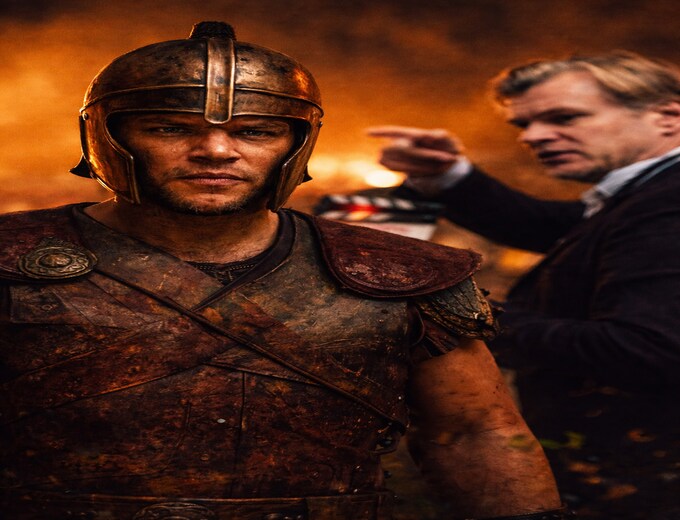
Christopher Nolan is set to return to cinemas in 2026 with an adaptation of The Odyssey, the ancient Greek epic traditionally attributed to Homer. Scheduled for release on 17 July 2026, the film marks one of the most ambitious projects of the director’s career, combining classical literature with large-format filmmaking and an ensemble cast.
The project, confirmed by Encyclopaedia Britannica and studio announcements, sees Nolan write and direct a feature-length retelling of the journey of Odysseus, king of Ithaca, whose decade-long attempt to return home after the Trojan War forms one of the cornerstones of Western storytelling. The scale of the undertaking reflects Nolan’s established reputation for blending historical or literary material with technical innovation.
A foundational story revisited
Homer’s Odyssey, composed around the eighth century BCE, follows Odysseus as he navigates a succession of trials, including encounters with the Cyclops, the enchantress Circe and the Sirens, while his wife Penelope and son Telemachus await his return. The poem explores endurance, loyalty, cunning and the human desire for home.
Although the epic has inspired numerous stage and screen interpretations, full-scale cinematic adaptations remain comparatively rare. Nolan’s decision to approach the text signals an effort to reintroduce the narrative to contemporary audiences with modern production values while preserving its mythic core.
The film forms part of a continuing trend in Hollywood towards large-scale literary adaptations, yet its association with Nolan distinguishes it within the marketplace. His previous works have combined spectacle with psychological depth, often examining the moral complexity of central characters.
Production scale and technical ambition
The Odyssey is being produced by Syncopy, Nolan’s production company, in collaboration with Universal Pictures. Filming has taken place across multiple international locations, including parts of Europe and North Africa, chosen for their natural landscapes and historical resonance.
In keeping with Nolan’s longstanding advocacy for celluloid, the production has been shot using IMAX film cameras. The director has repeatedly argued for the immersive qualities of large-format film, particularly for stories requiring visual scope. That commitment to analogue techniques aligns with his earlier projects, including the Oscar-winning Oppenheimer, which also utilised IMAX technology extensively.
The decision to film in large format suggests that The Odyssey will prioritise physical environments and practical effects wherever possible. This approach reflects Nolan’s preference for in-camera techniques over digital visualisation, a hallmark of his recent filmmaking.
Cast and character focus
Matt Damon leads the cast as Odysseus, marking another collaboration between the actor and Nolan following their work on Interstellar and Oppenheimer. Damon’s casting places a seasoned dramatic performer at the centre of a role that demands both physical presence and emotional complexity.
Tom Holland appears as Telemachus, Odysseus’ son, whose parallel coming-of-age journey forms a key narrative strand within Homer’s text. Anne Hathaway, another frequent Nolan collaborator, also features in the ensemble, alongside Robert Pattinson, Zendaya and Lupita Nyong’o. Specific character assignments beyond the central roles have not been fully detailed in official studio materials.
The breadth of the cast indicates a multi-layered narrative structure, reflecting the episodic nature of the source material. As in the original poem, the story is expected to move between Odysseus’ travels and events unfolding in Ithaca.
Context within Nolan’s career
The Odyssey follows the commercial and critical success of Oppenheimer, which won seven Academy Awards and grossed more than $900 million worldwide. That performance strengthened Nolan’s standing as one of the few contemporary directors able to combine artistic credibility with large-scale box office returns.
Adapting Homer represents a shift from recent historical and science-driven narratives to mythic storytelling. However, thematic continuities are evident. Nolan’s films frequently explore time, identity and moral responsibility, themes that resonate strongly within the structure of The Odyssey.
Industry analysts view the 2026 release as a significant event in the global film calendar. A mid-July premiere positions the film within the traditional summer blockbuster window, while its literary pedigree suggests awards-season ambitions later in the year.
Balancing myth and modernity
Adapting an ancient epic for modern cinema presents inherent challenges. The poem’s episodic structure, divine interventions and extended passages of verse demand careful translation into visual storytelling. Maintaining narrative cohesion without oversimplifying the text will be central to the film’s reception.
At the same time, the universality of the story offers clear advantages. The themes of displacement, perseverance and reunion continue to resonate across cultures and eras. For contemporary audiences, the odyssey can be read both as a physical journey and as a metaphor for resilience amid uncertainty.
Nolan’s previous work suggests he is likely to approach the material with structural experimentation while retaining emotional clarity. His films often unfold across interwoven timelines, a device that could align naturally with the parallel narratives of Odysseus and his family.
Anticipation ahead of 2026 release
Although detailed plot information remains limited, anticipation surrounding The Odyssey continues to build. The combination of classical source material, a prominent director and a high-profile cast positions the film as one of the most closely watched releases of 2026.
For UK audiences, the adaptation also reflects an enduring educational connection to Homer’s work, which remains a staple of literature curricula. The film therefore carries both cultural and commercial significance.
As production progresses towards its July 2026 debut, The Odyssey stands as a testament to the enduring power of ancient storytelling. More than two millennia after its composition, Homer’s epic is once again set to travel, this time across global cinema screens under the direction of one of modern filmmaking’s most recognisable figures.
