


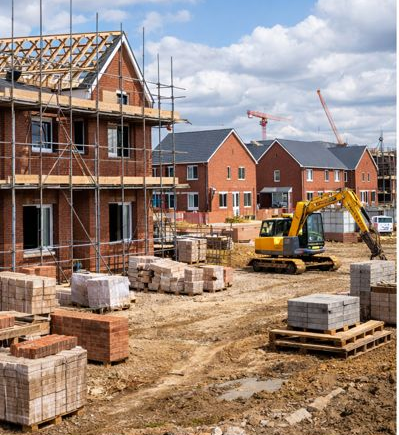
Housing supply has remained one of the most persistent structural challenges facing the UK economy. Despite repeated policy interventions and periods of strong construction activity, the number of homes built each year has continued to fall short of underlying demand. This imbalance has contributed to sustained affordability pressures, particularly in urban areas and regions with strong employment growth.
Official figures published by the Office for National Statistics show that household formation has consistently outpaced new housing delivery over the past decade. Population growth, longer life expectancy, and changing household patterns have all added to demand, while supply-side constraints have proven more difficult to resolve.
Planning Constraints and Development Timelines
One of the most frequently cited structural barriers to increasing housing supply lies within the planning system. While planning controls play an important role in managing land use and protecting local environments, they also shape the speed and scale at which new homes can be delivered.
Data from the Department for Levelling Up, Housing and Communities indicates that a significant proportion of approved housing developments experience delays before construction begins. These delays can stem from infrastructure requirements, financing conditions, or local objections that extend project timelines.
Housing economists have long noted that even modest delays can have a cumulative effect on overall supply, particularly when demand continues to rise during the same period.
The Role of Market Conditions and Financing
Broader market conditions also influence housing delivery. The cost of borrowing, availability of development finance, and construction input prices all affect whether projects move forward as planned.
The Bank of England has previously highlighted that periods of higher interest rates can place pressure on both developers and buyers. For developers, increased financing costs may reduce the viability of marginal projects. For buyers, tighter affordability can slow sales, which in turn affects cash flow and construction schedules.
These dynamics help explain why housing supply often responds slowly to shifts in demand, reinforcing the structural nature of the challenge rather than reflecting short-term market fluctuations.
Regional Disparities in Housing Availability
Housing supply issues are not evenly distributed across the UK. Some regions face acute shortages driven by strong job markets and limited land availability, while others experience slower development due to weaker demand or infrastructure limitations.
Analysis from the National Audit Office has previously pointed to mismatches between where homes are built and where demand is strongest. Addressing these regional imbalances often requires coordinated investment in transport, utilities, and public services, rather than housing policy in isolation.
As a result, supply constraints in high-demand areas can persist even when national construction figures appear relatively stable.
Social Housing Pressures and Long-Term Demand
Demand pressures are particularly visible within the social housing sector. Waiting lists have remained elevated in many local authorities, reflecting both limited new supply and the loss of existing stock through redevelopment or conversion.
Housing analysts, including economist Kate Barker, have previously argued that long-term underinvestment in social housing has intensified affordability challenges across the wider market. When lower-cost options are scarce, pressure shifts into the private rental sector, contributing to higher rents and reduced mobility.
This interconnectedness highlights how supply constraints in one segment can ripple across the entire housing system.
Policy Responses and Structural Limitations
Successive governments have introduced measures aimed at increasing housing delivery, ranging from planning reforms to financial incentives for developers. While some initiatives have led to incremental improvements, structural constraints have limited their overall impact.
Public finance specialists such as Paul Johnson have noted that housing outcomes are shaped by long-term investment decisions rather than short policy cycles. Infrastructure funding, skills availability in the construction sector, and land-use planning all require sustained coordination to produce measurable change.
This perspective reinforces the view that housing supply challenges are rooted in systems and structures, rather than isolated policy choices.
Why the Supply Gap Matters Beyond Housing
The implications of constrained housing supply extend beyond the property market itself. Limited availability can restrict labour mobility, affect productivity, and influence regional economic performance. Employers in high-cost areas may face recruitment challenges, while households experience reduced flexibility when moving for work or family reasons.
Economists have repeatedly linked housing affordability to broader economic resilience, suggesting that supply constraints can act as a drag on long-term growth.
A Persistent Issue With No Quick Resolution
Housing supply remains a structural challenge because it sits at the intersection of planning policy, market conditions, public investment, and demographic change. While incremental improvements are possible, meaningful shifts tend to occur over extended timeframes rather than within single policy cycles.
For policymakers, developers, and households alike, understanding the underlying causes of supply constraints is essential to assessing both current conditions and future housing outcomes. As official data continues to show demand outpacing delivery, housing is likely to remain a central issue in the UK’s economic and social landscape.
Read More on British Wire
