


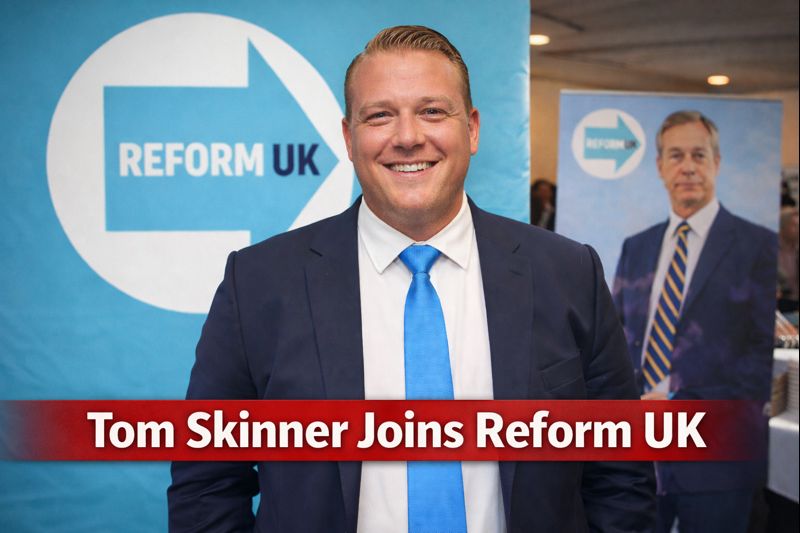
Tom Skinner has formally joined Reform UK, aligning himself with the party led by Nigel Farage as it continues to build momentum ahead of the next general election. The move was confirmed through a widely shared social media post showing Skinner and Farage together, accompanied by a caption referencing Skinner’s well-known catchphrase.
The announcement marks a clear shift from informal political commentary to formal party affiliation for Skinner, who rose to national prominence as a contestant on The Apprentice and has since built a large following online. His decision comes at a time when Reform UK is actively seeking to broaden its appeal beyond traditional political circles.
From television personality to party member
Skinner first became a public figure through his appearance on The Apprentice, where his outspoken style and direct manner made him a memorable presence. Since leaving the programme, he has maintained a high profile through social media and broadcast appearances, often commenting on political and social issues in a style that emphasises plain speaking and frustration with established politics.
By formally joining Reform UK, Skinner has moved beyond casual endorsement into active alignment with a political party. While there has been no suggestion that he will stand for elected office, his membership signals a willingness to publicly associate his personal brand with Reform UK’s platform and leadership.
Why Reform UK is embracing familiar faces
Reform UK has increasingly looked to high-profile individuals to amplify its message. Under Farage’s leadership, the party has positioned itself as an alternative to both Labour and the Conservatives, appealing to voters who feel disengaged from mainstream politics.
Recent opinion polling has regularly placed Reform UK in double digits nationally, making it a significant presence in the political landscape even where it does not yet hold seats won at general elections. Much of the party’s parliamentary representation to date has come through defections rather than direct electoral victories, a fact that underscores its reliance on visibility, media attention and brand recognition as it seeks to convert support into votes.
Skinner’s public profile fits that strategy. With a following that extends beyond traditional political audiences, his involvement offers Reform UK a route to reach voters who may not closely follow party politics but are familiar with him as a media figure.
Skinner’s political positioning
Although best known for entertainment television, Skinner has been increasingly vocal about his political views in recent years. He has criticised what he describes as a political system detached from everyday experience, arguing that many voters feel ignored by professional politicians.
In previous interviews and broadcasts, Skinner has spoken favourably about Farage’s leadership style, presenting him as more direct and relatable than leaders of the main parties. Those views now sit within a formal party context, giving them greater political weight than when expressed as personal opinion.
Mixed reaction from supporters and critics
Reaction to Skinner’s decision has been divided. Supporters have welcomed his move, describing it as an example of someone from outside politics engaging directly rather than merely commenting from the sidelines. On social media, backers have argued that his presence could help Reform UK communicate with voters who feel excluded from political debate.
Critics, however, have questioned the value of celebrity involvement in politics, suggesting that public recognition does not equate to policy expertise. Some have also argued that high-profile endorsements risk shifting attention away from scrutiny of party policies and towards personalities instead.
This tension reflects a broader debate in UK politics about the role of media figures in shaping political discourse, particularly at a time when social platforms allow individuals with large followings to exert significant influence.
What this means for Reform UK’s wider strategy
Skinner’s decision highlights how Reform UK is continuing to blur the line between politics, media and popular culture. Rather than relying solely on traditional campaigning, the party has leaned heavily on recognisable figures and social media visibility to maintain relevance and drive engagement.
As the next general election approaches, Reform UK faces the challenge of turning sustained polling support into tangible electoral success. High-profile members may help raise awareness, but the party’s long-term impact will depend on whether it can translate attention into votes in key constituencies.
A notable moment in a changing political landscape
For Skinner, joining Reform UK represents a significant evolution in his public role, moving from television personality and commentator into formal political participation. For Reform UK, it is another example of a strategy that prioritises visibility and connection with voters who feel alienated from mainstream politics.
While it remains too early to assess the electoral impact of Skinner’s involvement, his decision underlines how British politics continues to change, with parties increasingly drawing on figures from outside traditional political pathways. As campaigning intensifies, the effectiveness of that approach will become clearer, both for Reform UK and for others watching closely from across the political spectrum.
