


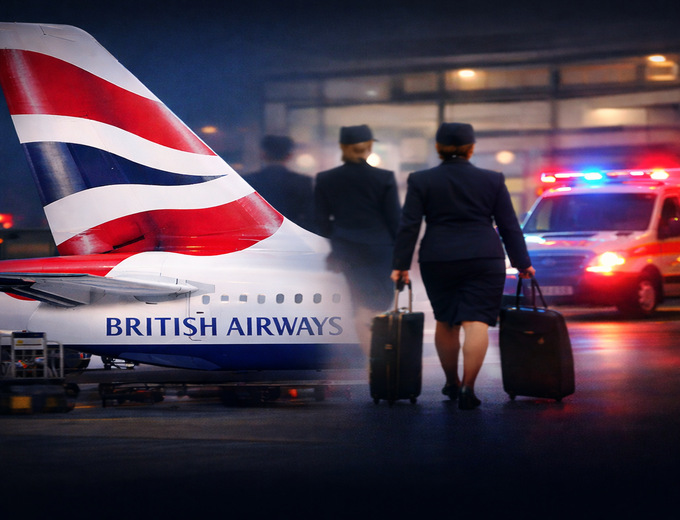
Three members of cabin crew working for British Airways were taken to hospital in Los Angeles after unknowingly eating cannabis-infused sweets given to them by a passenger, prompting the airline to launch an internal investigation.
The incident happened after a long-haul service from London to Los Angeles. The crew members consumed the sweets after the aircraft had landed and they were travelling to their hotel. Shortly afterwards, they began to feel unwell, reporting symptoms consistent with the effects of high-strength THC, the psychoactive component of cannabis.
British Airways confirmed the staff members have since recovered and said there was no impact on passengers or the return flight to the UK.
What happened on the Los Angeles stopover
According to reports first carried by the London Standard, the sweets were handed to cabin crew as a gift by a passenger. Such gestures are not unusual in commercial aviation, where travellers occasionally offer chocolates or snacks as a token of appreciation.
However, in this case, the sweets were allegedly infused with cannabis. The crew members were unaware of their contents when they consumed them after landing in Los Angeles.
While travelling to their hotel, three staff began to feel disoriented and unwell. One described the sensation as akin to an “out-of-body” experience. Concerned colleagues sought medical assistance, and the affected crew were transported to hospital for assessment.
They were later discharged.
The airline replaced the operating crew for the return sector to London, ensuring the scheduled service was not disrupted.
Airline response and internal review
In a statement, British Airways said safety remains its top priority and confirmed that an investigation is under way. The airline has not indicated that disciplinary action will be taken against the crew members, as they did not knowingly consume a controlled substance.
The carrier is understood to be examining how the sweets were brought on board and whether any procedures need to be strengthened regarding the acceptance of food items from passengers.
Commercial aviation operates under strict rules governing crew fitness for duty. Staff must remain unimpaired while on duty and during mandatory rest periods ahead of operating flights. Although the sweets were eaten after landing, any incident involving psychoactive substances inevitably raises questions about risk management and safeguarding.
The legal context around cannabis edibles
Cannabis laws vary significantly between jurisdictions. In parts of the United States, including California, recreational cannabis products are legal under state law and are widely sold in regulated outlets. Edible products, including sweets and gummies, are a common format.
However, THC remains a controlled substance under UK law. Bringing cannabis products across borders, or distributing them without disclosure, may breach both aviation security rules and drug legislation.
Experts note that edible cannabis products can contain high concentrations of THC and often have a delayed onset. This can lead to stronger-than-expected effects, particularly for those unfamiliar with the substance. Symptoms may include dizziness, anxiety, confusion and altered perception all of which can be distressing.
Although there was no suggestion of in-flight impairment in this case, aviation specialists say the episode underlines the importance of vigilance around unknown substances.
Implications for airline operations
Incidents involving crew welfare are taken seriously within the aviation sector. Cabin crew are trained primarily as safety professionals. In an emergency, they are responsible for evacuation procedures, first aid and ensuring passenger compliance with safety instructions.
Any factor that could affect alertness or cognitive performance is therefore scrutinised carefully by airlines and regulators.
British Airways’ decision to replace the crew for the return journey reflects established operational safeguards. Airlines maintain standby arrangements to ensure that services can continue even if staff become unavailable due to illness or other unforeseen circumstances.
Industry observers suggest the case may prompt carriers to reiterate guidance on accepting gifts, particularly edible items whose ingredients are not clearly labelled.
Passenger behaviour under the spotlight
The episode also highlights broader concerns about passenger conduct. While most travellers comply with airline rules, there has been increasing attention in recent years on disruptive or inappropriate behaviour on flights.
Aviation authorities across Europe and North America have introduced tougher penalties for serious misconduct, including fines and potential prosecution.
If it is established that a passenger knowingly distributed cannabis-laced products without disclosure, that could raise legal questions under both local and international law. At present, no public details have been released about the individual involved.
Protecting trust in commercial aviation
For British Airways, the immediate operational impact appears limited. The affected crew recovered, the return flight proceeded with a replacement team, and there was no reported disruption to customers.
However, incidents of this nature carry reputational sensitivity. Airlines operate in a sector built on trust; trust that crew are fit to fly, that safety procedures are robust, and that passenger welfare is protected at all times.
The swift medical response and operational substitution demonstrate established contingency planning within the industry. Yet the episode serves as a reminder that even seemingly minor interactions can carry unexpected consequences.
As the internal review continues, attention will focus on whether procedural adjustments are required. In an environment where aviation safety standards are among the most tightly regulated in the world, even unusual incidents such as this can trigger policy reflection.
For now, British Airways maintains that its customers were unaffected and that safety protocols functioned as intended.
The case may prove to be an isolated lapse in judgement by a passenger. But within commercial aviation, where margins for error are narrow, it also reinforces a simple principle: crew wellbeing is inseparable from passenger safety.
