


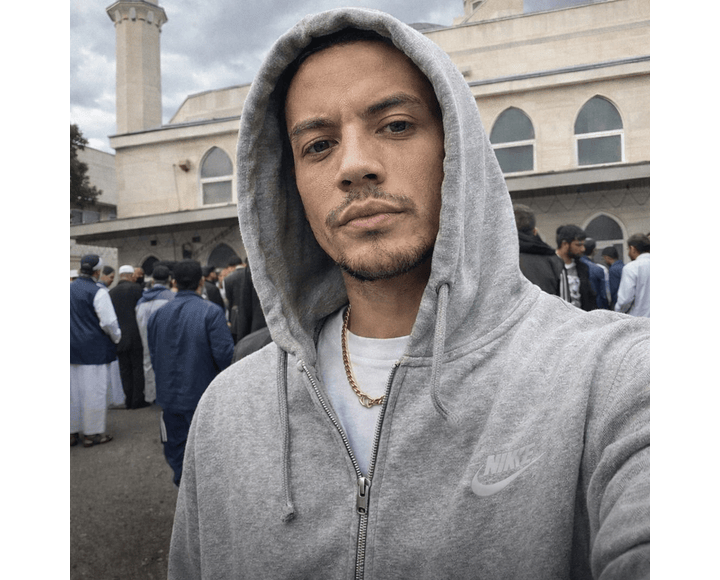
British rap star Central Cee has surprised fans and triggered widespread discussion online after publicly announcing his conversion to Islam. The West London artist, whose real name is Oakley Neil Caesar-Su, revealed the deeply personal change during a livestream, describing it as a moment of spiritual transformation and a new chapter in his life and identity.
The announcement marks a significant moment not only for the 27-year-old musician’s personal journey but also for how his evolving public identity may intersect with his status as one of the UK’s most successful contemporary artists.
A Surprise Revelation on Livestream
Central Cee’s conversion was confirmed during a live online session, where he stated he had “taken his Shahada”, the Islamic declaration of faith and described himself as a Muslim. In his own words: “I just changed my name and took my Shahada, I am Muslim now.” Friends present in the room congratulated him in the video.
The rapper, who grew up in Shepherd’s Bush, West London, has not publicly discussed his religious beliefs before in such specific terms. Prior to this announcement, his spiritual identity had largely remained private.
Who Is Central Cee?
Central Cee rose to prominence within the UK drill scene before becoming one of British rap’s most internationally recognised figures. Born on 4 June 1998 in Ladbroke Grove, London, he gained widespread attention with breakout tracks such as Day in the Life and Loading in 2020, which helped him bridge underground drill with mainstream success.
His mixtapes Wild West (2021) and 23 (2022) both achieved high chart positions in the UK Albums Chart, with the latter debuting at number one. He has also amassed billions of streams globally, making him one of the most listened-to UK rappers in recent years.
These achievements have positioned Central Cee not simply as a drill artist but as a crossover figure in British music, with influence spanning rap, pop culture and fashion.
A Personal Turning Point
The live stream announcement of his conversion caught many followers off-guard. It came during a period when the rapper was already enjoying significant commercial success and visibility, suggesting that the choice was rooted in personal conviction rather than career strategy.
Taking the Shahada, uttering an Islamic testimony of faith is a gesture that signals formal acceptance of Islam. For many Muslims, it represents a profound spiritual commitment and the beginning of a new religious life. Central Cee’s decision therefore places him among a small but notable group of high-profile entertainers who have publicly embraced the faith.
This kind of public conversion in the entertainment sphere often becomes a catalyst for broader conversation about faith, identity and representation within the music industry and society at large.
Reactions and Online Discussion
Central Cee’s announcement has generated a broad range of responses online. Many fans responded with messages of support and congratulations, celebrating the rapper’s declaration of faith as a positive personal milestone. Others have been more cautious or curious, questioning how this change might affect his public persona and artistic expression.
Some supporters even speculated on potential new names for him post-conversion, though Central Cee has not publicly confirmed a new Islamic name at this time.
While reactions vary across social media platforms, the central theme in many discussions is respect for personal choice, a reflection of how public figures’ private lives increasingly intersect with their artistic narratives in the age of digital fandom.
Context Within Music and Identity
Artists’ spiritual journeys have long been part of the cultural landscape. Within hip hop and broader music culture, faith and belief systems have frequently influenced artistic direction and personal storytelling. In the UK, where multicultural identities are often at the forefront of social discourse, Central Cee’s conversion highlights the ways in which personal faith journeys intersect with public life.
Whether this change will influence his music, lyrics or broader creative direction remains to be seen. His public declaration could inform new artistic themes, or it may remain a personal matter that coexists alongside his work as a rapper.
Central Cee’s Career and Influence
Central Cee’s rise reflects an evolution in British music in which artists from drill and urban genres command significant mainstream attention. Beyond commercial success, his influence extends into fashion, culture and the global music conversation.
Recent collaborations, such as his track Wave with Nigerian artist Asake, illustrate his ability to navigate international musical partnerships and reach diverse audiences.
Given his standing in contemporary music, any significant personal decision, particularly one as profound as a religious conversion naturally attracts attention, commentary and discussion.
What This Means for Fans and Culture
Central Cee’s public embrace of Islam is more than a news item; it reflects broader currents in pop culture where personal belief and public identity frequently intersect. In a media environment that increasingly values authenticity and personal storytelling, high-profile spiritual developments can resonate deeply with audiences.
For British audiences in particular, the rapper’s announcement comes at a time of ongoing dialogue about identity, multiculturalism and the role of religion in public life. While the immediate impact on his music career remains uncertain, the news has undoubtedly added a new layer to his evolving public narrative.
