


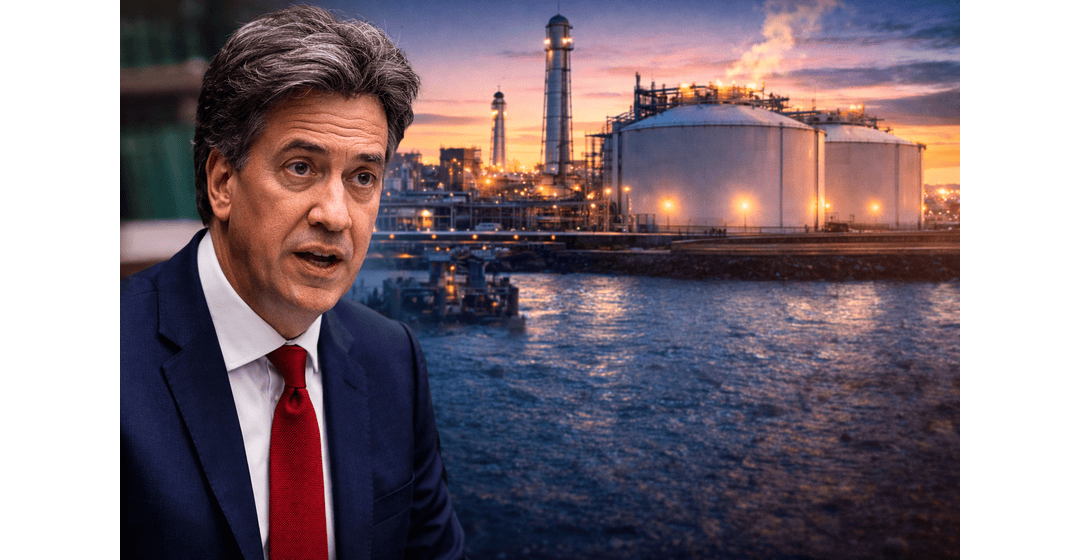
Officials advising Ed Miliband have forecast that wholesale gas prices could continue to fall for much of the next decade, according to internal projections reported this week. The assessment, prepared within the Department for Energy Security and Net Zero, suggests global supply growth may keep prices lower for longer than previously expected.
The forecast arrives at a politically sensitive moment. Energy costs remain a dominant issue for households and businesses across the UK, and Labour’s long-term energy strategy has centred on reducing reliance on fossil fuels to protect consumers from volatility. If gas prices decline steadily, the policy debate over the pace and cost of transition is likely to intensify.
What the Forecast Suggests
The internal modelling reportedly points to a gradual easing in wholesale gas prices compared with the peaks seen during the energy crisis of the early 2020s. Officials are said to expect additional liquefied natural gas supply from major exporters, improved storage levels across Europe and more stable global trading conditions.
Wholesale gas costs play a central role in the UK’s energy system. Gas often sets the marginal price for electricity generation, meaning fluctuations in global markets quickly feed into domestic supply costs. When prices surged after Russia’s invasion of Ukraine, household bills rose sharply despite regulatory intervention.
If wholesale costs trend downward in a sustained way, it would mark a shift from the extreme volatility that characterised the period between 2021 and 2023.
Does Lower Gas Mean Lower Bills
The crucial question for consumers is whether falling wholesale prices will translate into cheaper household energy.
Domestic tariffs are shaped by more than the commodity price. Network charges, policy costs and supplier operating margins also form part of the final bill. The regulator, Ofgem, adjusts the energy price cap periodically to reflect movements in wholesale markets and other cost components.
Even if gas becomes cheaper globally, retail bills may not fall proportionately. Analysts often stress that while commodity prices drive headline volatility, structural costs within the UK energy system remain significant.
That distinction matters politically. Forecasts of cheaper gas could soften the urgency of reform in some quarters, but households will judge policy largely on the numbers that appear on their statements.
The Political Tension
Miliband has repeatedly argued that heavy dependence on imported fossil fuels left Britain exposed during the energy crisis. His case for accelerating renewables and domestic generation rests on the claim that clean power offers greater long-term price stability.
The new projections complicate that narrative. If global gas remains affordable, critics may question whether large-scale investment in alternative infrastructure delivers immediate consumer benefit.
Supporters of transition policy counter that short-term price movements should not dictate long-term strategy. Gas markets have a history of abrupt swings, and geopolitical risks have not disappeared. A temporary easing does not eliminate vulnerability to future shocks.
Lessons From the Energy Crisis
The spike in gas prices earlier in the decade exposed structural weaknesses in European energy security. Several UK suppliers collapsed as wholesale costs surged, triggering government support schemes and emergency interventions.
While markets have stabilised since then, average household energy bills remain above pre-crisis levels. Businesses in energy-intensive sectors continue to cite input costs as a constraint on growth.
The possibility of sustained price relief will therefore be watched closely. Lower wholesale gas costs could ease pressure on public finances if subsidy requirements decline. They may also provide space for targeted support or tax adjustments.
What Happens Next
Forecasts are not guarantees. Energy markets remain influenced by global demand, weather patterns, infrastructure reliability and geopolitical developments. A single supply disruption can quickly reverse price trends.
For policymakers, the challenge lies in balancing immediate affordability with long-term resilience. Decisions taken now will shape the UK’s exposure to future market movements.
For households, the priority remains straightforward. Consumers want clarity on whether bills will fall and when. If wholesale projections prove accurate and feed through to retail tariffs, the political landscape around energy policy may shift.
