


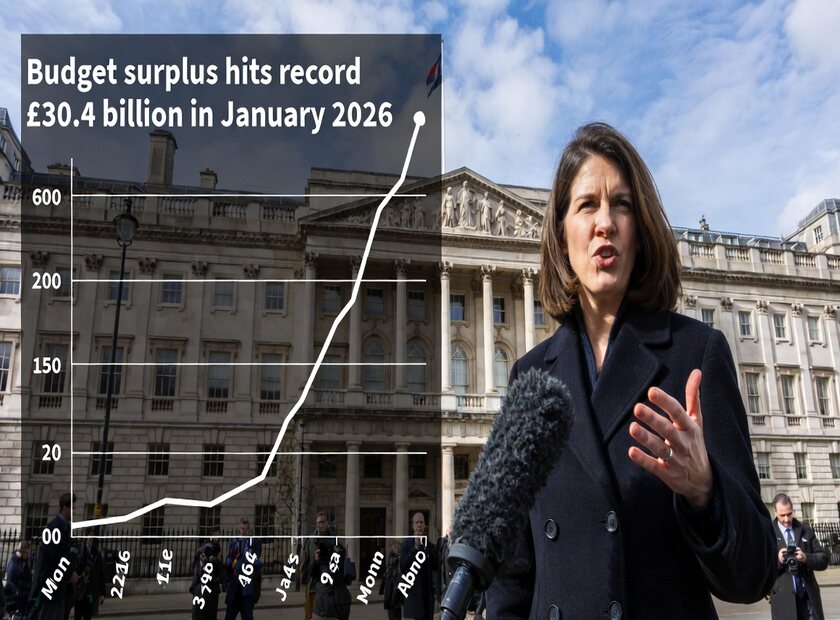
The UK public finances delivered a stunning surprise this week, posting the largest monthly budget surplus on record.
According to official data released by the Office for National Statistics (ONS) on 20 February, the government recorded a £30.4 billion surplus in January 2026. This is the highest monthly surplus since comparable records began in 1993 and nearly double the £15.4 billion surplus seen in January 2025.
The figure smashed analysts’ expectations of around £23.8 billion and beat the Office for Budget Responsibility’s (OBR) November forecast by more than £6 billion. For Chancellor Rachel Reeves, the news comes as a timely boost just 10 days before her Spring Statement on 3 March.
The Numbers at a Glance
- January 2026 surplus: £30.4 billion
- January 2025 surplus: £15.4 billion (almost doubled)
- Tax receipts in January: £133.3 billion (up 13.8% on last year)
- Self-assessment income tax + capital gains tax: £46.4 billion (up £10.5 billion)
- Capital gains tax alone: Nearly £17 billion (69% higher than January 2025)
- Current budget surplus (day-to-day spending): £40.9 billion
- Borrowing for first 10 months of financial year (April 2025–Jan 2026): £112.1 billion (down 11.5% or £14.6 billion on last year)
- Public sector net debt: 92.9% of GDP (still near early-1960s levels)
Why Was the Surplus So Large?
January is always a strong month for government finances because that’s when millions of self-assessment tax returns are paid. But this year the numbers were exceptional for three main reasons:
- Massive surge in capital gains tax Investors appear to have sold assets in late 2025 ahead of anticipated tax changes introduced in the October 2024 Budget. CGT receipts jumped to almost £17 billion, a 69% increase on the previous January.
- Higher income tax receipts Frozen personal tax thresholds continued to pull more people into higher tax bands as wages rose, adding an extra £3.6 billion compared with January 2025.
- Sharp fall in debt interest payments Lower inflation meant the government paid just £1.5 billion in interest on inflation-linked bonds, compared with £6.5 billion the previous January.
Taken together, total government spending was comfortably outpaced by the tax inflow, creating the record surplus.
A Major Boost for Rachel Reeves
The figures give Chancellor Rachel Reeves some much-needed positive headlines ahead of the Spring Statement. With borrowing for the year so far running £8.3 billion below the OBR’s forecast, she now has a little more breathing room.
Chief Secretary to the Treasury James Murray said:
“We know there is more to do to stop one in every £10 the government spends going on debt interest, and we will more than halve borrowing by 2030-31 so that money can be spent on policing, schools and the NHS.”
However, economists warn that the January figure is partly seasonal and should be viewed alongside February data before drawing firm conclusions about the full-year picture.
What Does This Mean for Ordinary People?
- No immediate tax cuts expected — The government has repeatedly said its fiscal rules are “non-negotiable”.
- Possible extra headroom — If the strong tax performance continues, Reeves may have slightly more flexibility in March to protect public services without raising taxes further.
- Debt still high — Even with the surplus, public sector net debt remains at 92.9% of GDP – levels last seen in the early 1960s.
Historical Context
This is the largest monthly surplus ever recorded in raw pounds (without adjusting for inflation). Previous records were set in January 2021 (£27.3 billion) and January 2019 (£19.5 billion). The January surplus is normal because of self-assessment deadlines, but the scale this year is unprecedented.
Expert Reaction
Paul Dales, Chief UK Economist at Capital Economics, said the strong public finances and retail sales data together suggest the economy started 2026 in better shape than many feared.
The Institute for Fiscal Studies (IFS) noted that while borrowing is falling faster than expected, the government’s long-term plan to reach a current budget surplus by 2028-29 still depends on sustained strong tax receipts and controlled spending.
What Happens Next?
The real test will come on 3 March when the Office for Budget Responsibility publishes its latest growth and borrowing forecasts in the Spring Statement. Markets and economists will be watching closely to see whether Reeves’ “headroom” has grown or shrunk.
