



Planning policy plays a decisive role in determining how much housing is delivered in the UK and where that development takes place. Long before construction begins, decisions made through local plans, land allocation frameworks, and approval processes shape the scale and timing of new housing supply.
While housing demand has remained elevated across much of the country, planning capacity and policy consistency vary widely between local authorities. This variation has become a central factor in explaining why housing delivery remains uneven despite sustained demand.
Permissions Granted Versus Homes Delivered
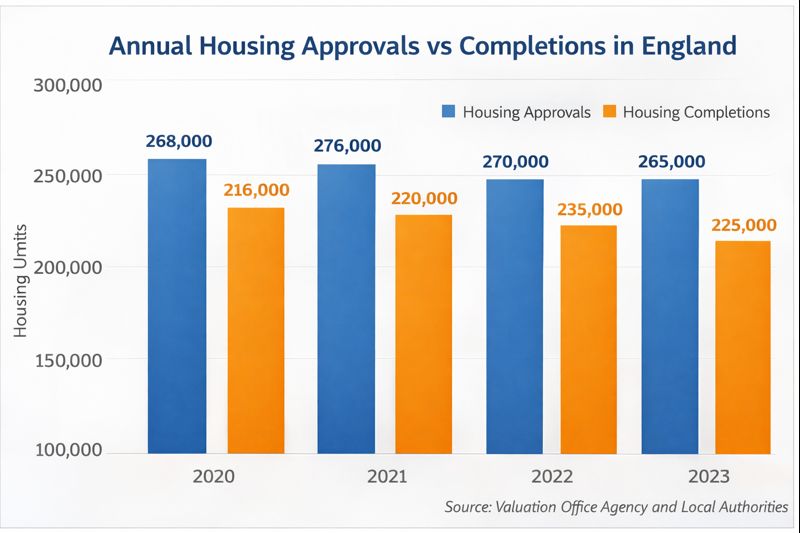
Official housing statistics show a persistent gap between the number of homes granted planning permission and those ultimately completed. Data compiled by the Valuation Office Agency and local authority monitoring reports indicate that more than 260,000 housing units are approved annually in England, yet annual completions have typically remained closer to 220,000 to 235,000 homes in recent years.
This gap suggests that between 25,000 and 40,000 homes per year do not progress from approval to completion within expected timeframes. Analysts note that this pattern has persisted across multiple economic cycles, pointing to structural rather than short-term causes.
Local Plans and Planning Capacity Constraints
A key driver of slower housing delivery lies in the uneven quality and coverage of local plans. According to assessments by the Royal Town Planning Institute, a significant share of local planning authorities operate with plans that are outdated or under review, limiting their ability to allocate land confidently and defend decisions against legal challenge.
Where local plans are absent or incomplete, planning decisions often take longer and are more likely to be contested. This can delay development timelines by several years, even where housing need is clearly established.
The RTPI has also highlighted staffing shortages within planning departments, noting that many councils report vacancy rates exceeding 15 per cent, reducing their capacity to process applications efficiently.
Infrastructure Dependencies and Delivery Delays
Planning outcomes are closely linked to infrastructure readiness. New housing developments typically depend on transport access, schools, healthcare provision, and utility connections being delivered alongside homes.
Evidence submitted by councils to the Local Government Association shows that infrastructure funding often lags behind housing approvals, particularly in high-growth areas. Where roads, public transport, or water capacity upgrades are delayed, construction may be postponed despite planning consent already being in place.
This disconnect between housing policy and infrastructure investment remains a recurring constraint on delivery.
Developer Phasing and Market Absorption
Once permission is granted, developers often deliver housing in phases rather than all at once. This approach reflects local demand conditions, sales rates, and financing structures rather than planning rules alone.
Research cited by the Royal Institution of Chartered Surveyors indicates that large sites are commonly built out over 10 to 15 years, even when full permission is secured early. Slower build-out rates can therefore contribute to supply constraints, particularly in areas with strong demand.
Market absorption limits mean that accelerating approvals does not automatically translate into faster completions.
Regional Differences in Planning Outcomes
Planning policy outcomes vary significantly by region. Areas experiencing strong population and employment growth often face tighter land constraints, environmental protections, and higher levels of objection, all of which can restrict supply.
Analysis by the Office for Budget Responsibility has previously noted that regions with the highest housing need frequently deliver the lowest number of homes relative to demand. This imbalance reinforces affordability pressures and widens regional disparities.
In contrast, areas with more available land but weaker demand may grant permissions that take longer to convert into completed developments.
Why Planning Reform Alone Has Limits
Successive governments have proposed planning reforms aimed at speeding up housing delivery. While procedural changes can improve efficiency at the margins, evidence suggests they cannot resolve delivery challenges on their own.
Planning professionals and housing economists generally agree that sustained delivery requires alignment between land allocation, infrastructure funding, labour availability, and market conditions. Without this coordination, reforms may increase permissions without significantly narrowing the completion gap.
This helps explain why housing supply responds gradually, even during periods of policy change.
A System That Shapes Long-Term Outcomes
Planning policy plays a central role in UK housing delivery because it influences decisions made years before homes are built. The interaction between local plans, infrastructure readiness, and development phasing means that housing outcomes reflect long-term system design rather than short-term policy shifts.
Read More on British Wire
