


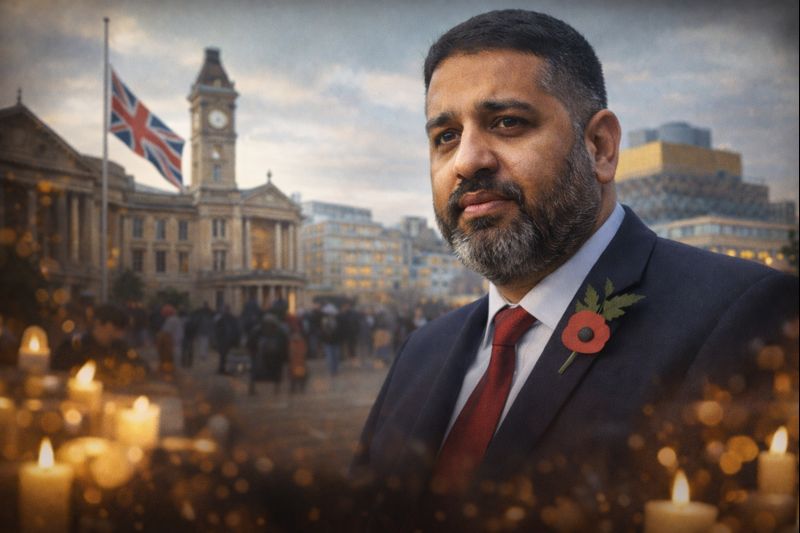
Waseem Zaffar, a senior figure within Birmingham City Council, has died suddenly at the age of 44. His death was confirmed on Friday, prompting tributes from across the political spectrum and renewed reflection on his influence within local government and community life in the West Midlands.
Zaffar, who represented the Balsall Heath West ward, had built a prominent profile within Birmingham’s Labour group and was regarded as one of the city’s most recognisable councillors. News of his death has been met with widespread shock among colleagues, residents and civic leaders, many of whom worked closely with him during a period of intense political and financial pressure for the council.
A leading voice at Birmingham City Council
Waseem Zaffar served for several years as a councillor in Europe’s largest local authority, playing an active role in debates that shaped Birmingham’s direction. He was widely known for his strong engagement with local communities and his willingness to speak publicly on issues affecting residents, from public services to social cohesion.
During his time on the council, Zaffar held senior responsibilities and frequently represented the authority in regional and national discussions. Colleagues described him as a committed public servant who combined political conviction with a deep understanding of the challenges faced by one of the UK’s most diverse cities.
His work took place against a difficult backdrop. Birmingham City Council has faced sustained financial strain in recent years, alongside major organisational reforms. Within that context, Zaffar became a familiar figure in council chambers, local media and community forums, often addressing contentious topics with directness and confidence.
Deep roots in Birmingham’s communities
Beyond formal council business, Zaffar maintained strong links with grassroots organisations and faith groups across the city. Residents of Balsall Heath West frequently cited his visibility at local events, surgeries and community meetings as evidence of his hands-on approach to representation.
He spoke openly about the importance of civic participation and local democracy, particularly among younger people and minority communities. For many supporters, his career symbolised a bridge between local government and communities that have historically felt distant from decision-making at city level.
Those who worked alongside him said he brought lived experience into political discussions, ensuring that policy debates reflected the realities of everyday life in Birmingham. That perspective shaped his contributions on housing, social services and neighbourhood regeneration, areas that remain central to the council’s agenda.
Sudden death and official confirmation
The council confirmed Zaffar’s death on Friday, describing it as sudden. No further details surrounding the circumstances have been made public, and the family has asked for privacy. Flags at council buildings were lowered as a mark of respect, and the authority announced plans to honour his memory at an upcoming council meeting.
Senior figures within the Labour group expressed their condolences, describing his passing as a profound loss for the council and the city. Messages of sympathy also came from opposition councillors, reflecting the regard in which he was held beyond party lines.
Local MPs and regional leaders paid tribute to his dedication to public service, noting that his death comes at a comparatively young age for someone who had already spent years in frontline politics. Many acknowledged that his voice would be missed during a critical period for Birmingham’s future.
Political career and public profile
Zaffar’s political journey reflected the changing face of local politics in major UK cities. He rose through the ranks during a time when councillors increasingly found themselves at the intersection of national policy decisions and local delivery challenges.
He was not without controversy during his career, and he often addressed criticism directly rather than retreating from scrutiny. Supporters argued that this openness demonstrated accountability, while critics sometimes questioned his approach. What remained consistent was his visibility and his readiness to engage in public debate.
In recent years, his profile extended beyond Birmingham, with appearances in regional media and involvement in broader discussions about local government reform. That prominence made news of his death resonate not only within the city but across the West Midlands political landscape.
Tributes from across the city
Following the announcement, tributes poured in from councillors, community leaders and residents. Many described Zaffar as passionate, energetic and deeply committed to Birmingham. Others highlighted his willingness to mentor younger activists and encourage participation in local politics.
Community organisations in Balsall Heath West spoke of his practical support during times of local difficulty, including funding challenges and neighbourhood disputes. For them, his role went beyond council meetings, extending into day-to-day advocacy and problem-solving.
Several tributes emphasised the personal impact he had on colleagues, noting his approachable manner and sense of humour even during tense political moments. That combination of seriousness and warmth shaped his relationships within the council and beyond.
Implications for Birmingham City Council
Zaffar’s death leaves a gap within Birmingham City Council at a time of significant transition. The authority continues to navigate financial recovery, service reform and public trust following years of scrutiny. Losing an experienced councillor with deep local knowledge will add to the challenges faced by the Labour group and the council as a whole.
A by-election will be required to fill the vacancy in Balsall Heath West, introducing a new political moment for the ward and its residents. In the interim, council leaders have indicated that support will be offered to constituents affected by his death, ensuring continuity of representation.
More broadly, his passing has prompted renewed discussion about the pressures faced by local politicians, particularly those balancing public responsibilities with community expectations. Colleagues have called for greater recognition of the demands placed on councillors in large urban authorities.
