


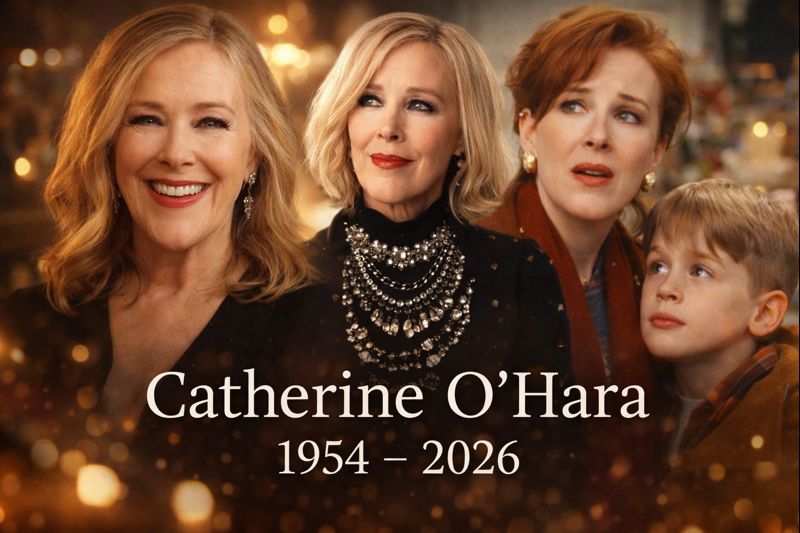
Catherine O’Hara, the Canadian-American actor and comedian whose career bridged cult sketch comedy, Hollywood family favourites and one of television’s most acclaimed modern sitcoms, has died at the age of 71. Her death was confirmed on Friday, ending a career that reshaped screen comedy while retaining a rare warmth and humanity.
O’Hara became a familiar presence to millions through films such as Home Alone and television’s Schitt’s Creek, but her influence ran far deeper than individual roles. Over five decades, she helped define ensemble comedy, proved that character work could be both broad and emotionally precise, and demonstrated that reinvention late in a career could still command global attention.
From Toronto improv to international recognition
Born in Toronto in 1954, O’Hara emerged from the city’s influential comedy scene in the 1970s. She was part of the Second City comedy company, where improvisation formed the backbone of her performance style. That grounding would shape her career, giving her a reputation for instinctive timing and a willingness to build characters collaboratively rather than rely on scripted punchlines alone.
Her early breakthrough came with SCTV, the sketch series that rivalled Saturday Night Live in North America during its peak years. On SCTV, O’Hara displayed a chameleonic ability to inhabit wildly different personas, from celebrity parodies to original comic creations. The show established her not just as a performer but also as a writer, cementing her standing among the most respected figures in North American comedy.
A defining presence in film comedy
While sketch television introduced O’Hara to audiences, film made her a household name. In 1990 she appeared as Kate McCallister in Home Alone, the frantic but determined mother searching for her son after accidentally leaving him behind. The role demanded sincerity as much as humour, and O’Hara delivered both. Her performance anchored the film’s emotional core, ensuring that the slapstick chaos unfolding on screen never lost its human centre.
The film’s global success led to a sequel and established O’Hara as a reliable presence in mainstream cinema. She followed this with a series of roles that benefited from her improvisational roots, particularly in mockumentary-style films directed by Christopher Guest. In productions such as Best in Show, O’Hara helped popularise a style of comedy that relied on character observation rather than overt jokes, influencing a generation of performers and writers.
Reinvention through Schitt’s Creek
If O’Hara’s early career showcased her versatility, her later work confirmed her enduring relevance. Her portrayal of Moira Rose in Schitt’s Creek became one of television’s most celebrated comic performances of the 2010s. Moira, a former soap opera star forced into small-town life, could easily have been caricature. Instead, O’Hara infused the role with vulnerability beneath the eccentric wigs, theatrical diction and extravagant wardrobe.
The series, which ran for six seasons, gained momentum through word of mouth and streaming audiences before sweeping the major comedy categories at the Emmy Awards in its final year. O’Hara received particular praise for transforming what might have been a supporting role into the show’s emotional and stylistic linchpin. For many viewers, Moira Rose became emblematic of how comedy can embrace absurdity while still offering genuine empathy.
Craft, collaboration and influence
Colleagues frequently described O’Hara as a performer who elevated everyone around her. Directors and fellow actors noted her generosity in ensemble settings and her instinct for sharpening scenes without dominating them. Her long professional partnerships, including with Eugene Levy and other SCTV alumni, reflected a collaborative ethos rooted in improvisation and mutual trust.
Beyond awards and acclaim, her influence could be measured in subtler ways. Contemporary comedians often cited her as a model for character-driven comedy, while younger performers pointed to her career longevity as proof that creative reinvention remains possible at any stage. She navigated shifts in the entertainment industry without sacrificing her distinctive style, moving from broadcast television to streaming platforms with apparent ease.
A career of recognition without excess
O’Hara never cultivated the celebrity persona often associated with Hollywood success. Publicly, she maintained a low profile, allowing her work to define her reputation. That restraint helped sustain a sense of authenticity that resonated with audiences across generations. While she received industry honours, including Emmy recognition, she rarely framed success in competitive terms, instead emphasising the collective effort behind memorable performances.
Her ability to balance acclaim with approachability made her a respected figure within the industry and a beloved one among viewers. Whether playing an anxious mother in a family film or an imperious socialite fallen on hard times, she conveyed emotional truth beneath the comedy.
Remembering a lasting legacy
Catherine O’Hara’s death marks the loss of a performer who shaped modern screen comedy while remaining rooted in the collaborative traditions of improv. Her body of work spans eras and formats, yet remains remarkably consistent in tone: intelligent, character-led and quietly humane.
For audiences in the UK and beyond, her performances will continue to circulate through repeated broadcasts, streaming libraries and seasonal traditions. Home Alone remains a staple of festive schedules, while Schitt’s Creek has secured a place in television history as a late-blooming phenomenon.
O’Hara leaves behind a legacy defined not by a single role but by a sustained commitment to craft. In an industry often driven by novelty, she demonstrated that careful observation, collaboration and emotional precision could endure. Her absence will be felt across comedy and film, but her work ensures that her presence will remain familiar for years to come.
