


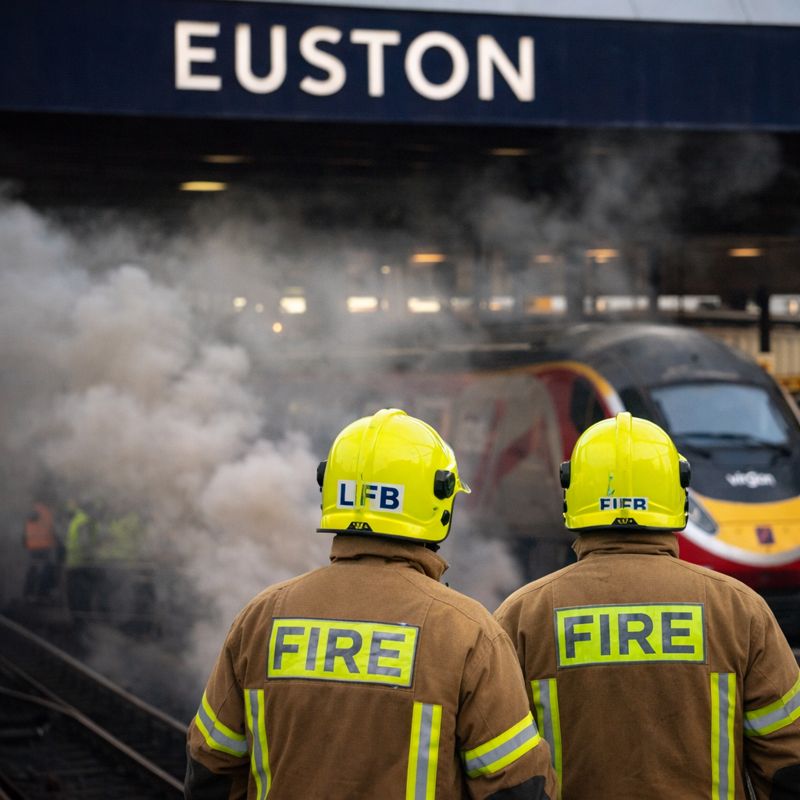
A fire near London’s Euston railway station caused widespread disruption to rail services on Wednesday, halting trains on the West Coast Main Line and leaving thousands of passengers facing delays and cancellations during one of the network’s busiest travel periods.
Emergency services were called after smoke was reported close to the station, prompting an immediate response from the London Fire Brigade. As a precaution, rail operators suspended services in and out of Euston while safety checks were carried out, bringing long-distance routes linking London with the Midlands, north-west England and Scotland to a standstill.
The incident affected multiple operators, including Avanti West Coast and London Northwestern Railway, with passengers advised not to travel unless absolutely necessary while disruption continued.
What Happened at Euston
According to officials, the fire broke out in the vicinity of railway infrastructure close to Euston station. Fire crews attended the scene and worked to bring the situation under control, with smoke visible in parts of the station area earlier in the day. There were no reports of serious injuries, and emergency services confirmed that the fire was extinguished before it could spread further.
Rail authorities closed sections of the station while engineers assessed the impact on signalling, power supplies and track safety. As a result, all departures and arrivals at Euston were suspended for several hours, with knock-on effects across the national rail network.
Transport officials stressed that safety was the overriding concern, noting that services would only resume once engineers were satisfied the area was secure.
Impact on Rail Services
The West Coast Main Line is one of the UK’s most critical rail corridors, carrying long-distance and commuter services between London and major cities including Birmingham, Manchester, Liverpool and Glasgow. Any disruption at Euston, its southern terminus, has immediate and far-reaching consequences.
Passengers reported crowded platforms at alternative stations, while many were advised to reroute via different lines or postpone journeys altogether. Some services were terminated short of London, while others were cancelled outright, leading to significant congestion on surrounding transport networks.
Rail operators issued repeated updates urging passengers to check before travelling and to expect delays well into the afternoon and early evening.
Response from Emergency Services and Rail Operators
The London Fire Brigade confirmed it had sent multiple crews to the scene and worked closely with rail staff to ensure the fire was safely contained. Once the immediate risk had passed, responsibility shifted to railway engineers, who began inspections to determine whether equipment had been damaged.
Rail companies activated disruption protocols, including ticket acceptance on alternative routes where possible. However, capacity constraints meant many travellers were still unable to complete their journeys as planned.
Industry sources acknowledged that incidents of this nature highlight the vulnerability of major transport hubs and the challenges involved in restoring services quickly after an emergency.
Passenger Experience and Travel Advice
For many passengers, the disruption came with little warning. Morning and early afternoon travellers described confusion as departure boards were cleared and announcements changed rapidly. Some passengers faced missed connections, while others were forced to make alternative arrangements at short notice.
Consumer groups reiterated advice for passengers affected by cancellations or significant delays, reminding travellers of their rights to refunds or compensation under rail conditions of travel. Passengers were encouraged to keep receipts for any additional costs incurred as a result of the disruption.
Rail operators continued to provide updates through station announcements, social media and journey planning apps as services gradually resumed.
Wider Implications for the Rail Network
The fire at Euston once again drew attention to the fragility of the UK’s rail infrastructure, particularly at key interchanges. With much of the network operating close to capacity, even relatively localised incidents can cascade into nationwide disruption.
Transport analysts note that while emergency responses are generally swift, recovery times depend heavily on whether core systems such as signalling or power supply are affected. In this case, the need for thorough safety inspections contributed to the length of the shutdown.
The incident also comes amid ongoing pressure on the rail industry to improve reliability and resilience, especially as passenger numbers continue to recover following recent years of fluctuating demand.
Services Gradually Resume
By later in the day, rail authorities confirmed that services were beginning to restart from Euston, although disruption was expected to continue for several hours as timetables recovered and trains were repositioned. Passengers were warned that residual delays and cancellations could persist into the evening.
Operators advised travellers to allow extra time, check live updates and consider travelling at quieter times where possible.
While the immediate emergency passed without serious injury, the scale of disruption served as a reminder of how quickly incidents at major transport hubs can affect travel across the country.
